

Aragonese Pyrenees · Aragón · Spain
The impressive Aragonese Pyrenees in Summer: Ordesa, Valle de Otal and the Benasque Valley
Ordesa is spectacular and unmissable, but Valle de Otal is the quieter memory.
A personal three-day summer trip through the Aragonese Pyrenees, with Ordesa, Valle de Otal, the Benasque Valley and practical hiking advice.
Quick facts
- Best for
- Mountain trails, national parks, summer road trips, waterfalls and traditional stone villages.
- Time needed
- Three days gave us two full hikes plus an easier day exploring the Benasque valley.
- Where to stay
- Torla-Ordesa for Ordesa and Otal; Castejón de Sos or Benasque for the Benasque valley.
- Good to know
- Summer is hot, walks are long, and you need a car.
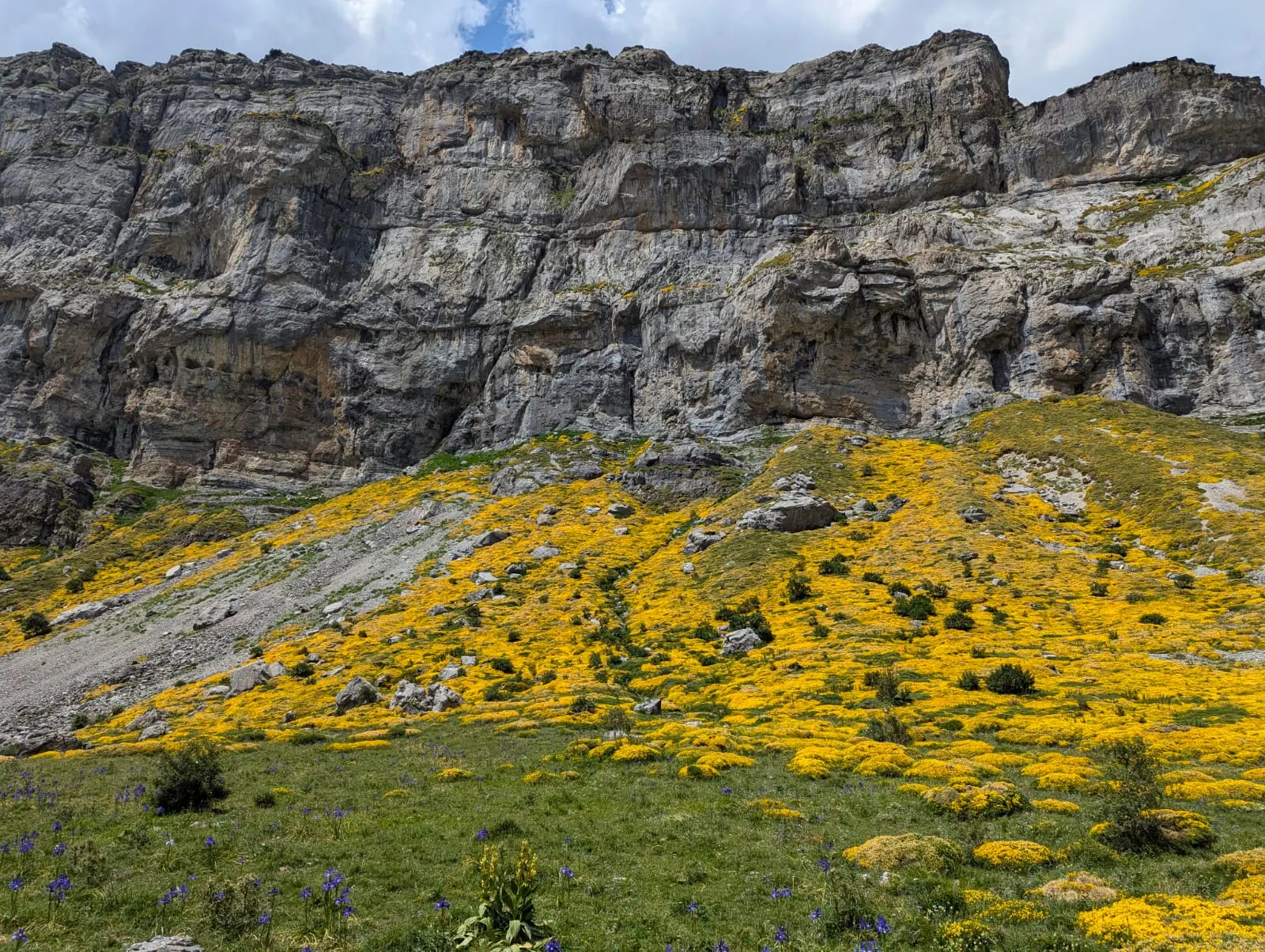
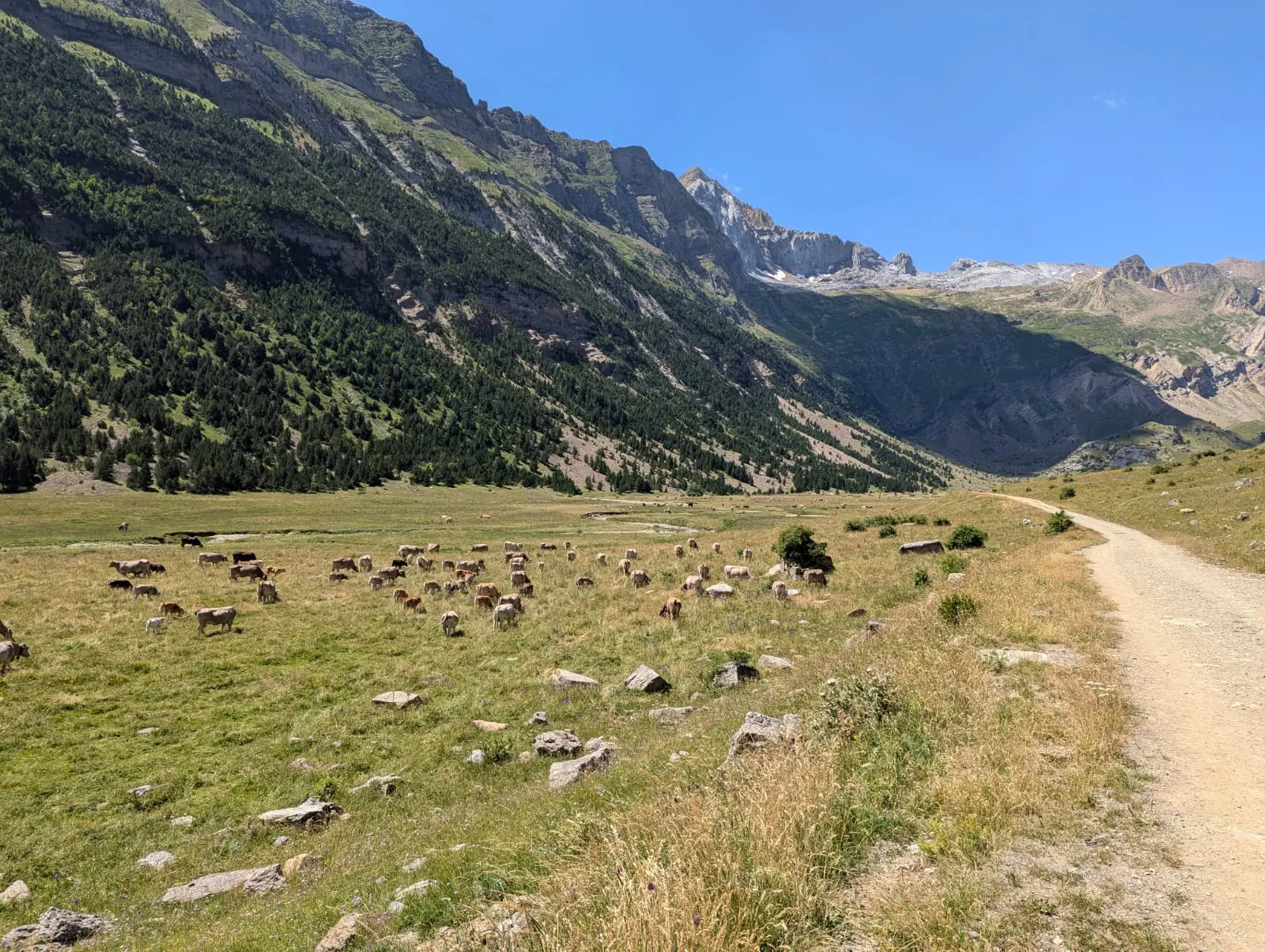
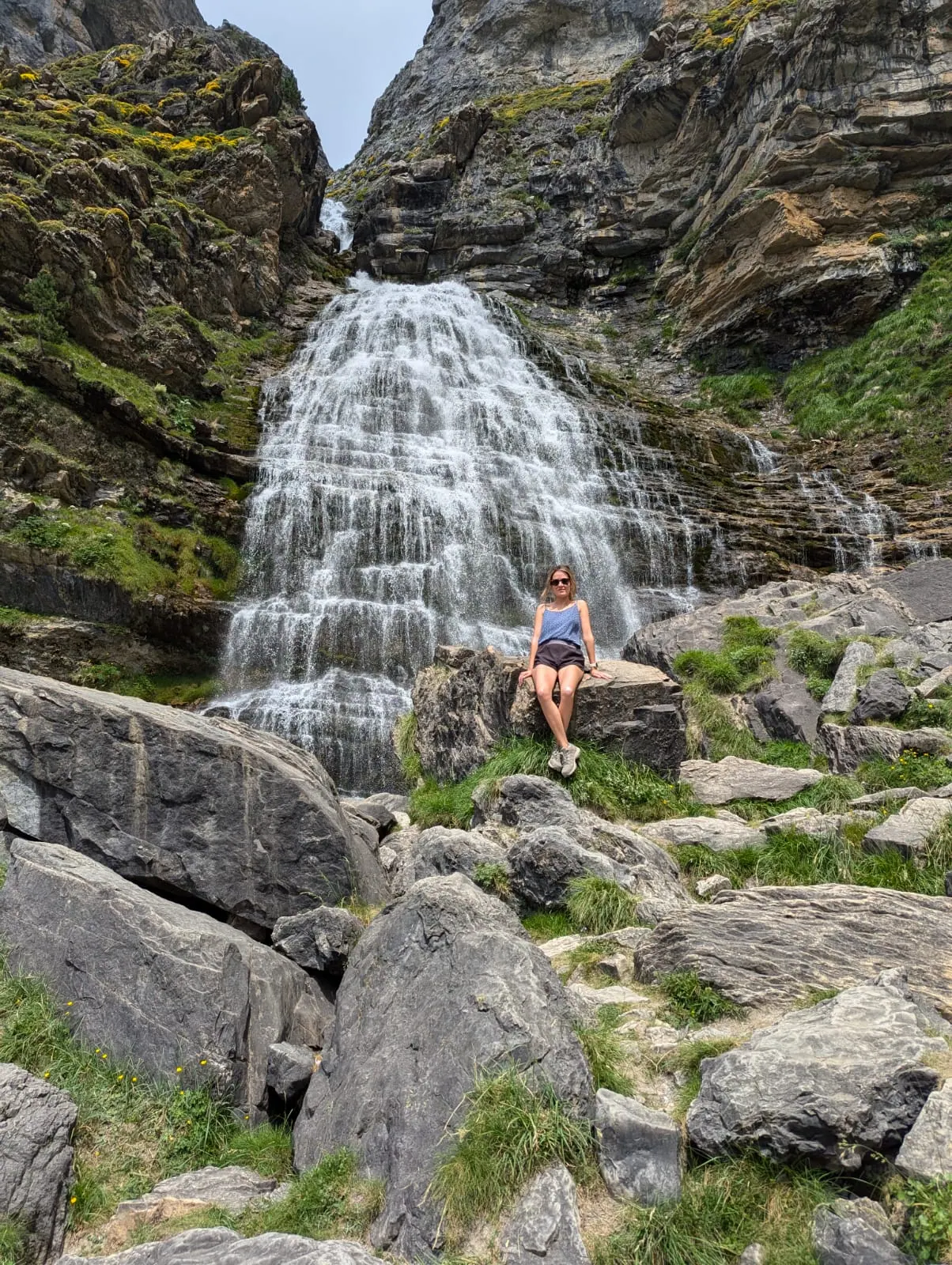
One thing worth knowing before you plan a trip here: “the Spanish Pyrenees” isn’t one single place. The range runs for more than 400 kilometres along the border with France, and on the Spanish side it passes through three regions. In the west are the Navarrese Pyrenees, greener and quieter, with valleys like the Roncal. In the east are the Catalan Pyrenees, home to the Aigüestortes national park and the ski resorts around the Val d’Aran. And in the middle sit the Aragonese Pyrenees, which is where we went.
We chose Aragón because it has the highest and most dramatic mountains of the whole range - Aneto, the highest peak in the Pyrenees, along with Posets and Monte Perdido, are all here in the province of Huesca - and because it holds Ordesa y Monte Perdido, the national park we most wanted to see.
We had three days here, which is not much for a mountain range this size. There are hundreds of routes, and choosing between them is difficult. In the end we picked two hikes based on scenery and on what friends had recommended, and deliberately avoided the hardest ones, because let’s be honest - we are not professional mountaineers. That turned out to be the right call, and those two walks ended up being the two halves of this trip: one that stayed quiet almost the whole way, and one where we shared the path with a lot of other people.
One warning before anything else. It was July, and we had assumed the mountains would be cooler. They were not. It was strikingly hot, and the heat shaped almost every decision we made.
Arriving: Broto
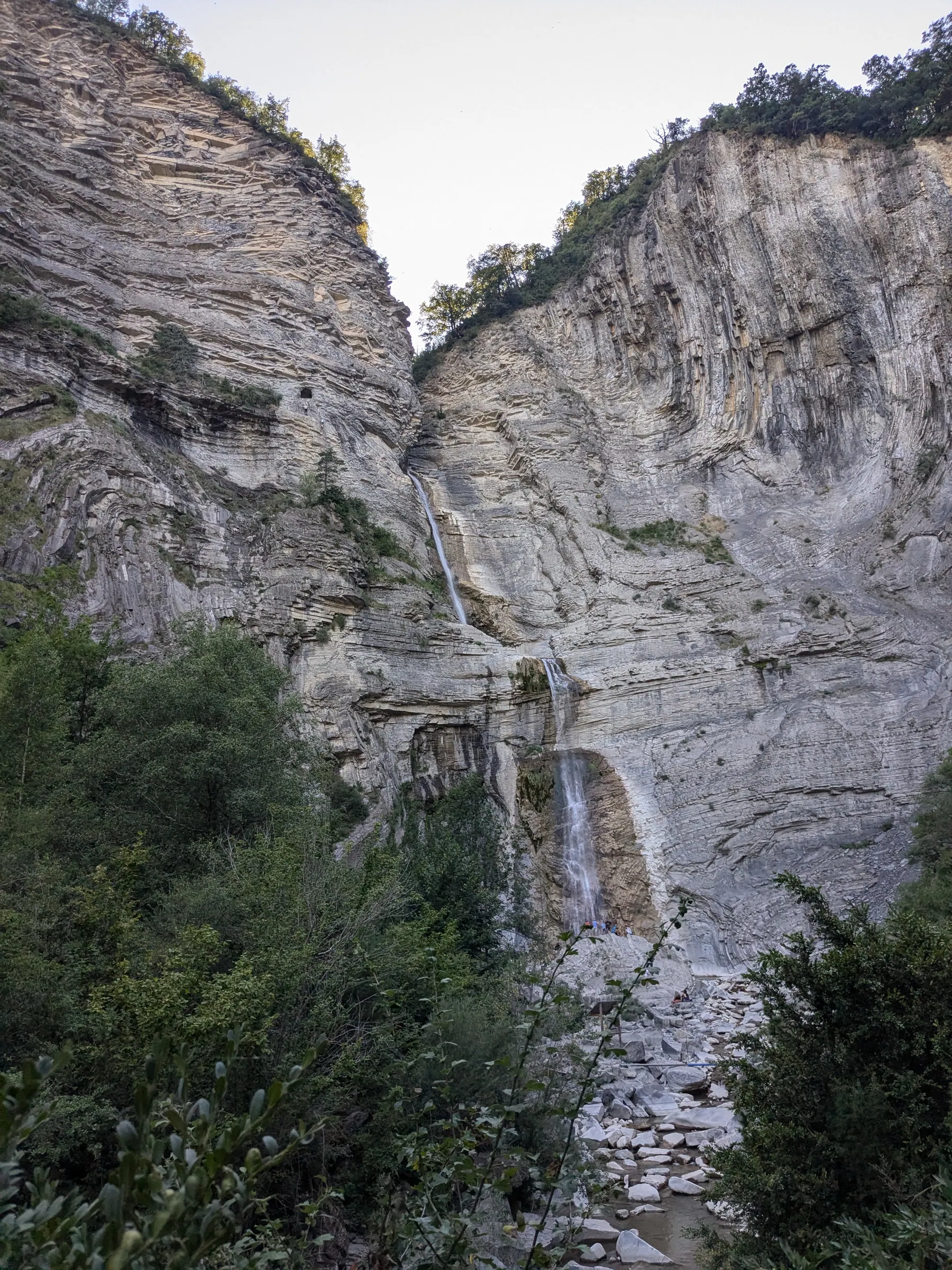
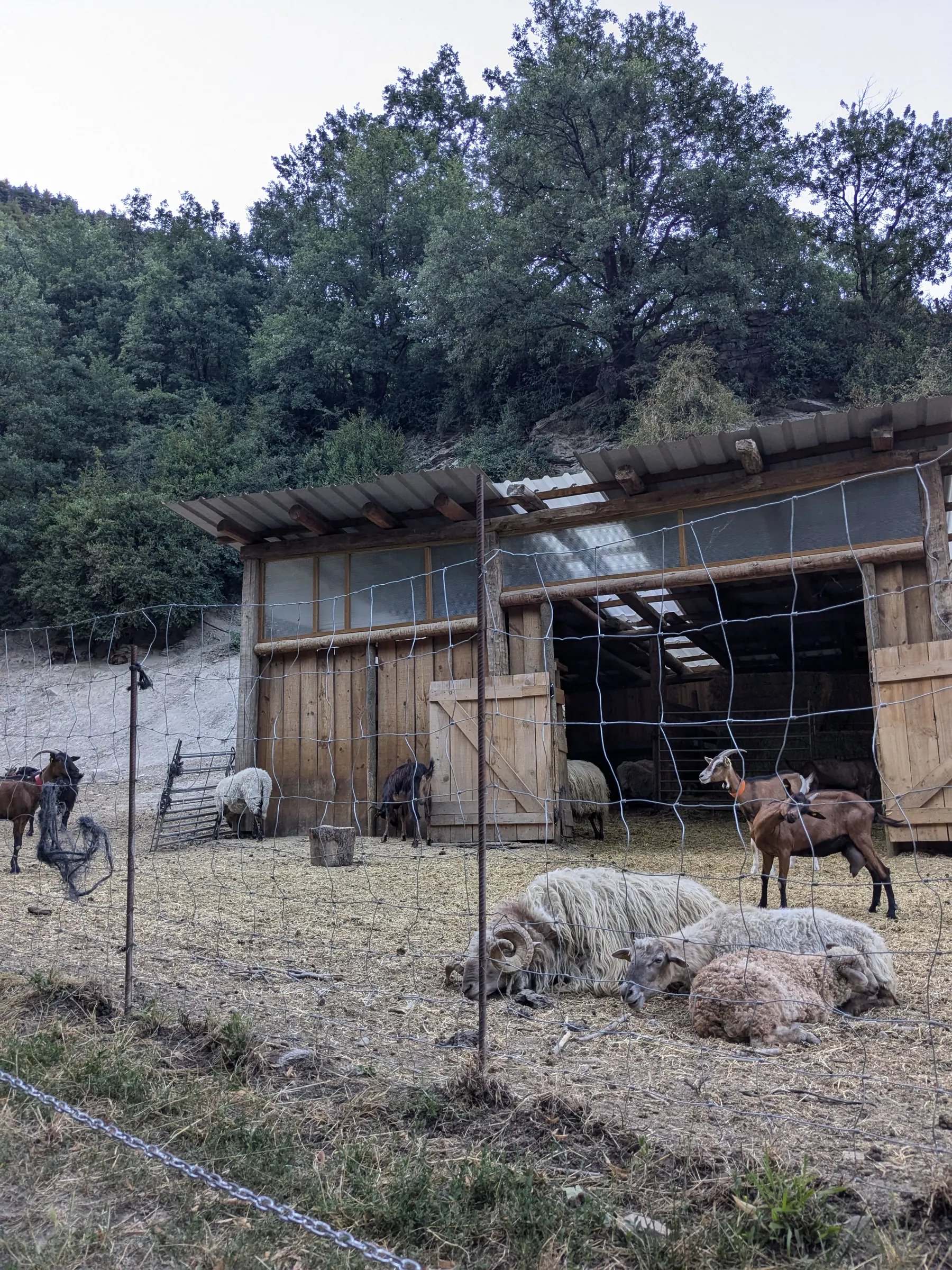
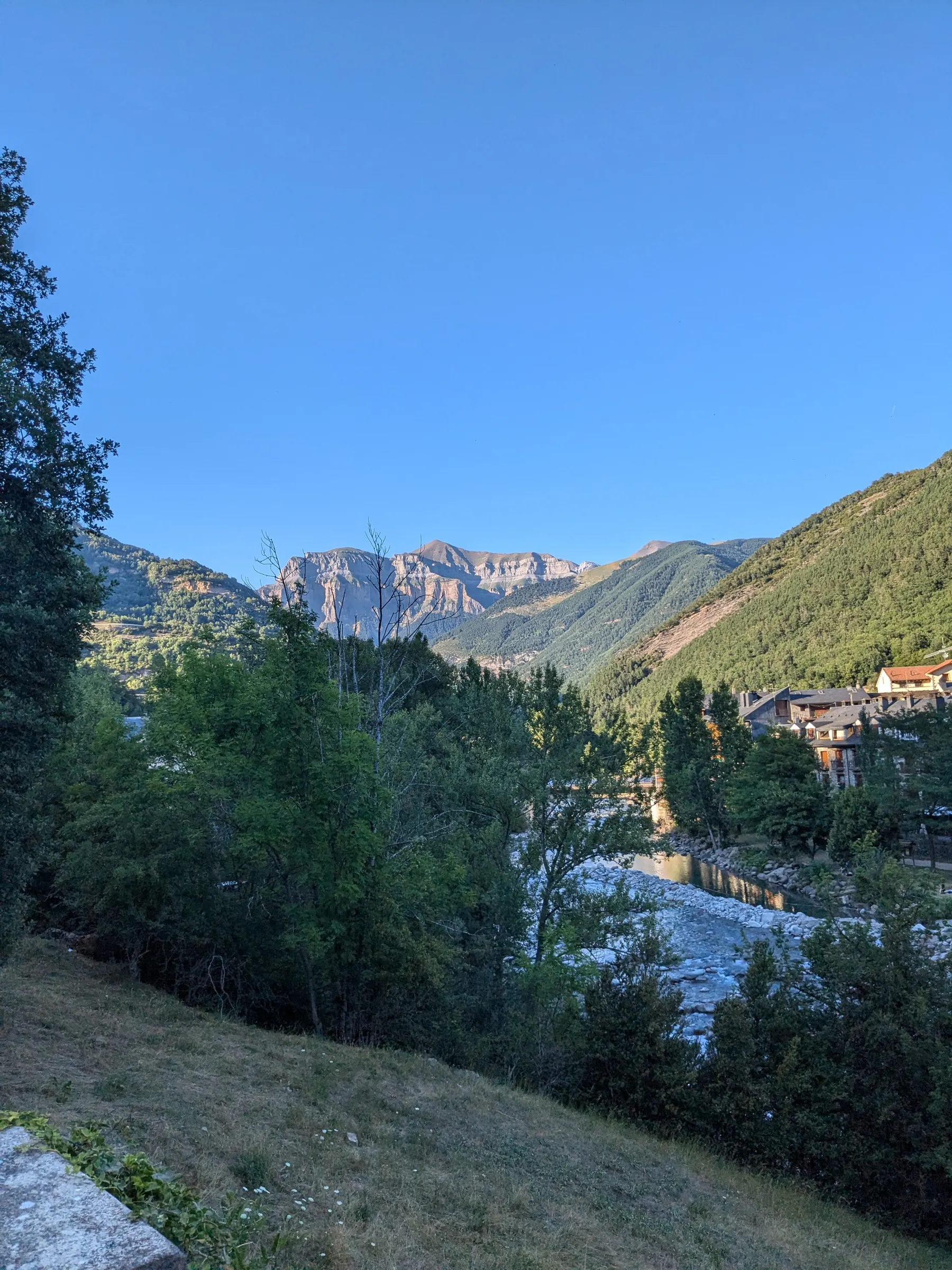
We reached the mountains in the evening and stopped in Broto, a small Pyrenean town that made a good first impression: a big waterfall right there, and a nice promenade along the river. We slept nearby, and it was a quiet way to start - the kind of place where you feel the mountains beginning.
Day 1: Valle de Otal, and an empty valley
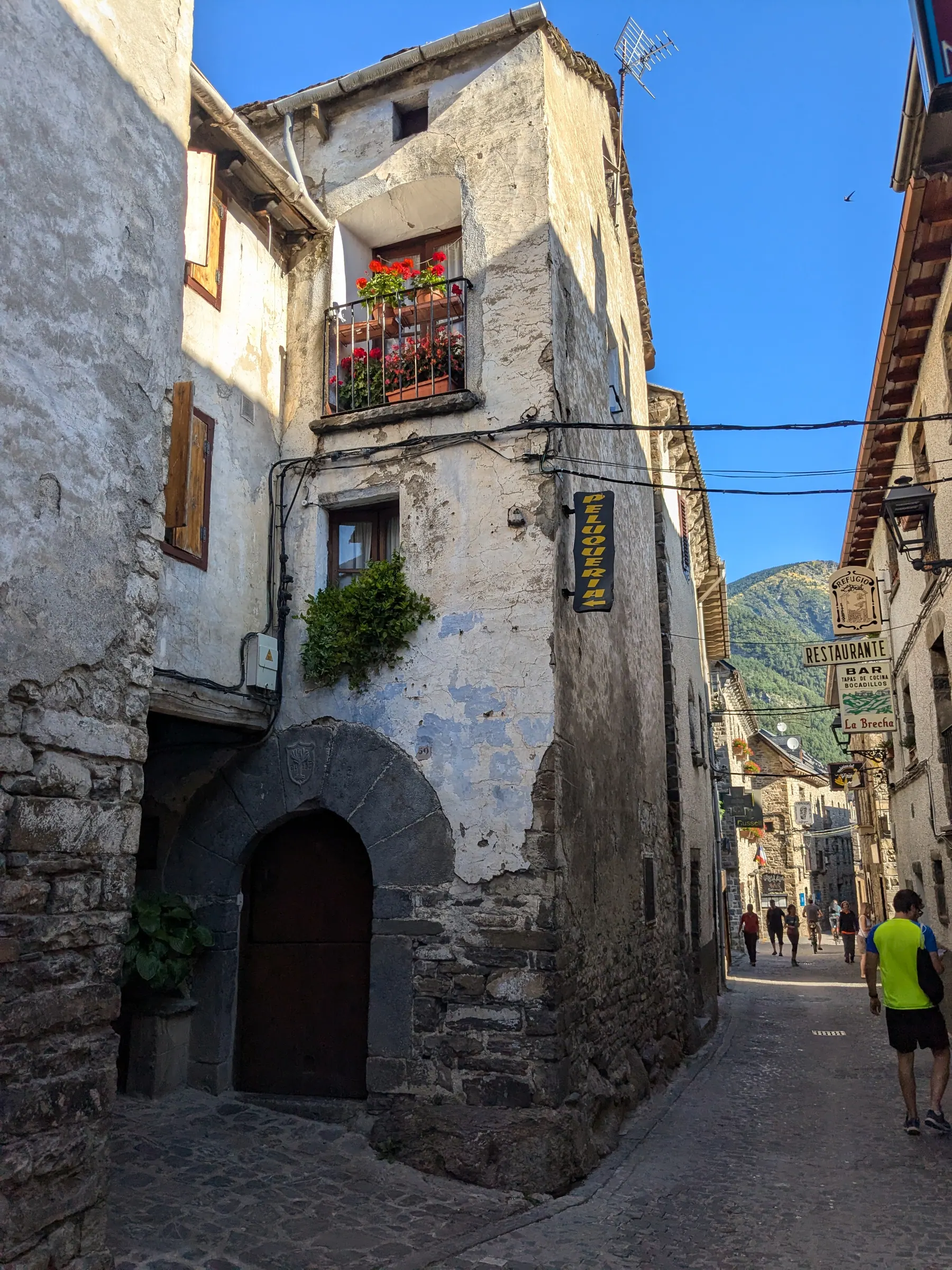
The next morning we drove to Torla-Ordesa, the main starting point for hikes in this area and a lovely medieval town in its own right. Narrow streets, stone houses, mountains behind it - worth a wander even if you’re only passing through.
From there we headed towards the Valle de Otal. We parked at the big car park by the Camping San Nicolás de Bujaruelo, right next to the Romanesque bridge of San Nicolás de Bujaruelo, which is a nice thing to see before you even start walking.
We began at 10:30, because we are not early risers. If you’re going in summer, I’d suggest starting earlier than we did - you’ll thank yourself later.
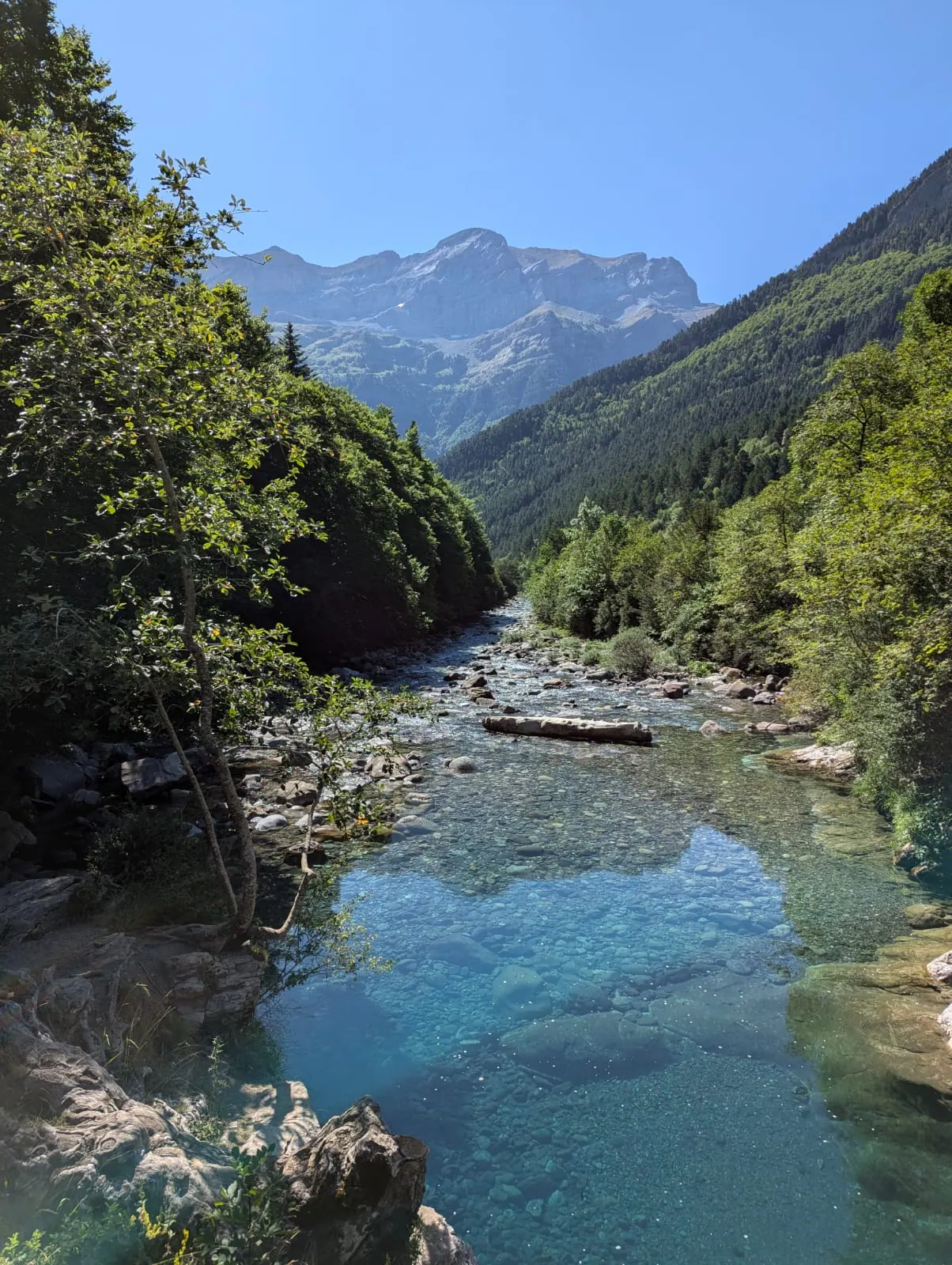
The first stretch was lovely and cool: the path follows a small river with turquoise water up through the Valle de Bujaruelo, along part of the ruta ornitológica (a birdwatching route). We stayed with the water for a while, crossed at the Puente de Oncins, and then began to climb. The ascent isn’t particularly steep, but it winds up the mountainside in long switchbacks and it isn’t easy either. We took a few breaks to drink water, and eventually we came out into the valley.
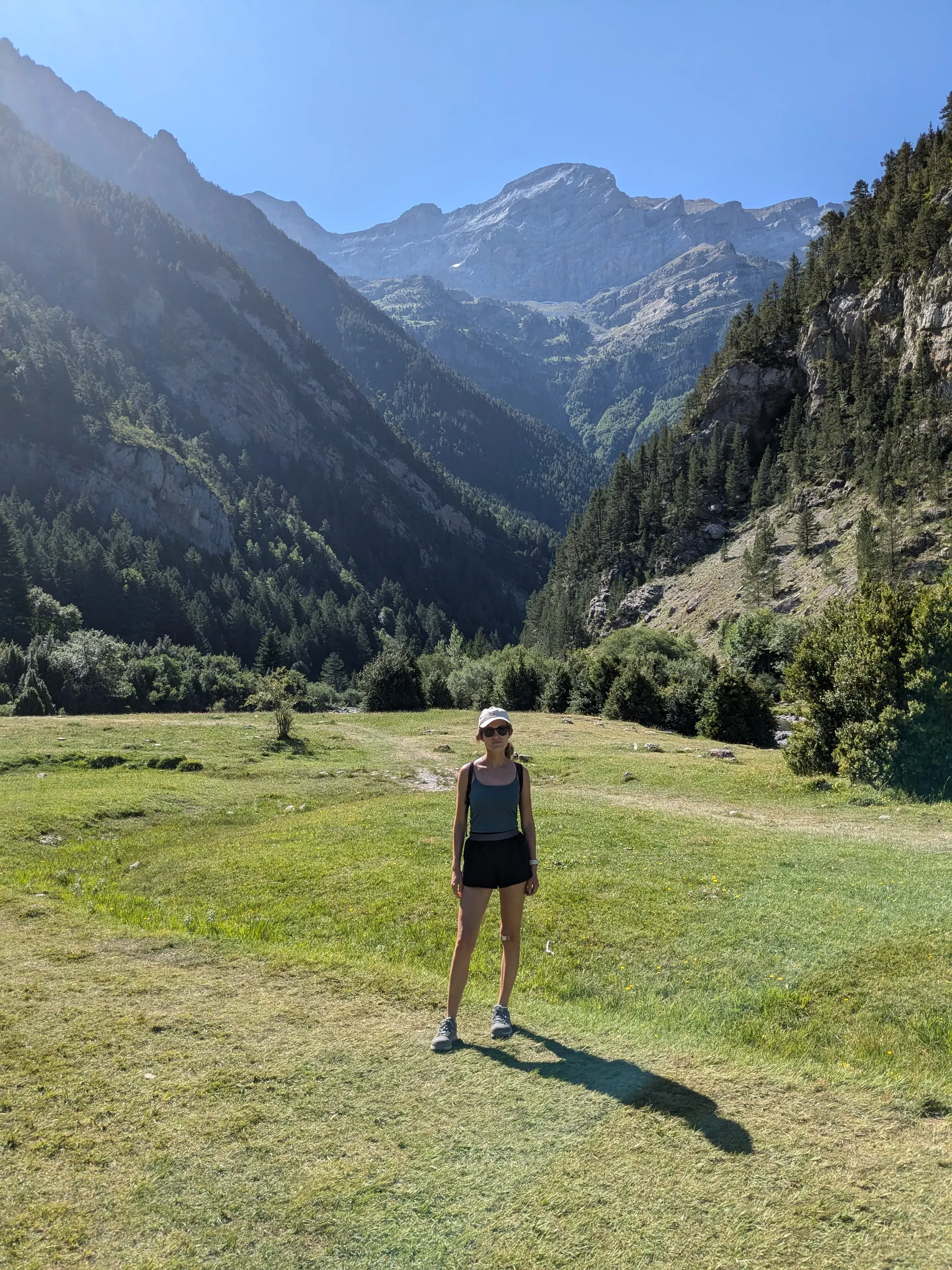
Standing at the entrance to the valley, we thought: fine, we’ll cross this quickly and reach the waterfall. We were wrong. The valley is huge, the heat was strong, and - this is important - it is completely open, with no shade at all. Crossing it took far longer than we expected.
But the views were extraordinary. Cows grazing, big blue skies with a few clouds, green all around. It looked, we joked, like the scenery from a Milka chocolate advert. We did meet some people along the way, but it stayed quiet, and for one long stretch we were the only ones there - nobody ahead, nobody behind, the whole valley to ourselves. That is a rare feeling in the mountains in summer, and it’s the thing I remember most about the whole trip.
At the far end we reached the Cascada de Otal, which felt like a reward: a waterfall and a river to cool down swollen legs. There were quite a few people gathered there, but it was still a very good moment.
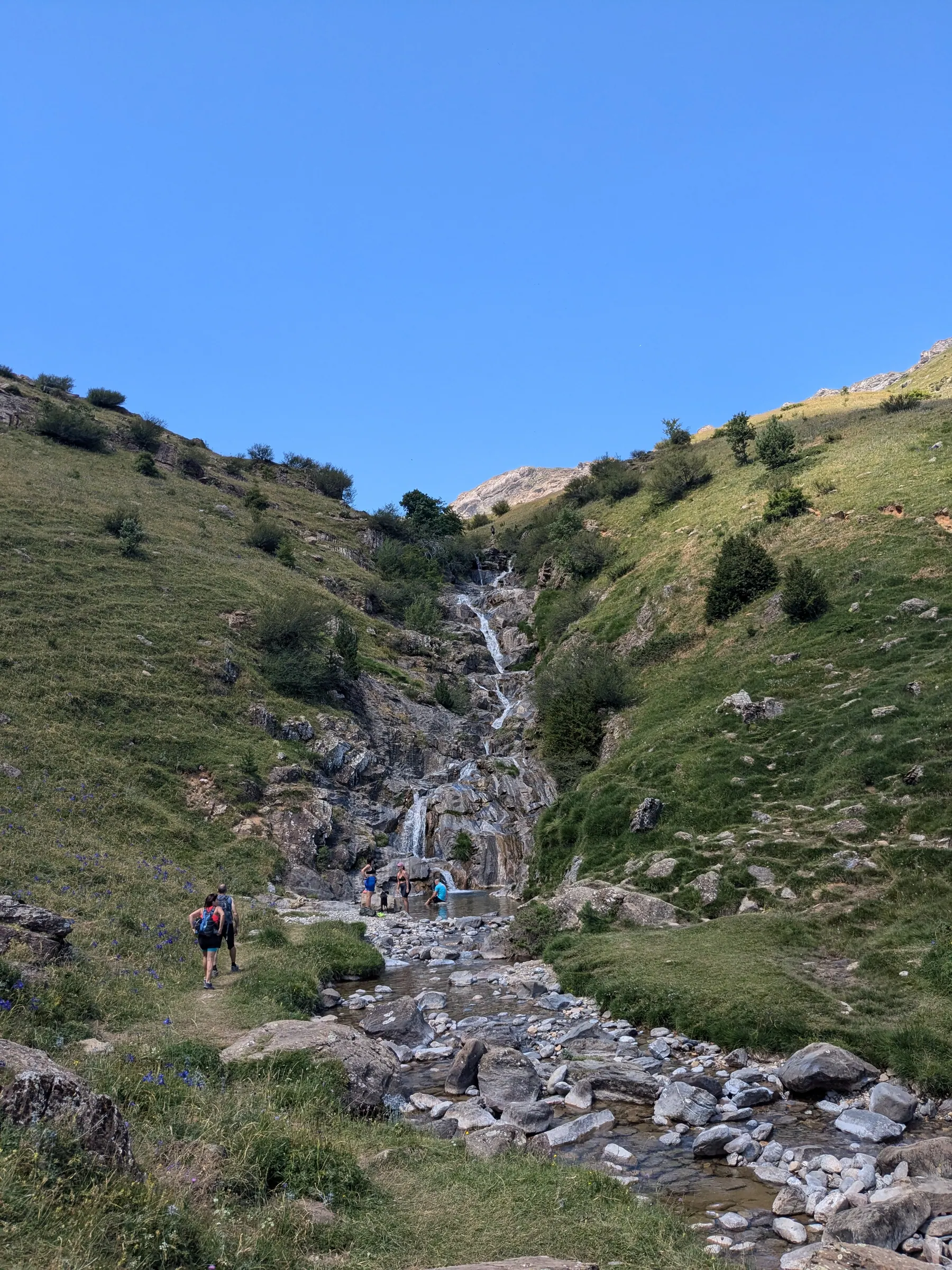
The whole hike is beautiful and not technically complicated, and the path is easy to follow. It’s the distance and the exposure that tire you, not the difficulty. We slept in Torla-Ordesa that night.
Day 2: Ordesa and the Cola de Caballo
This was the one we’d been waiting for - the walk through Ordesa y Monte Perdido National Park to the Cascada de la Cola de Caballo. We knew it would be beautiful. It’s the walk everyone comes here for.
It does need a little planning. In high season you can’t just drive to the park entrance. Instead you park in Torla-Ordesa and take a shuttle bus, which cost about €4.50 return when we went. We arrived at the bus stop around 9:00 - again, not early risers - and there was already a long, slow-moving queue. We bought pastries from a local bakery and waited about 40 minutes before we got on.
There’s no entrance fee for the park itself, and the path is very easy to follow. It starts as a cool walk through forest, with trees keeping the sun off and a steady climb, and then it opens out. Mountains all around, in all different colours, bees moving between the flowers. I’ve seen a fair number of mountains, and this was honestly one of the best views I’ve ever had.
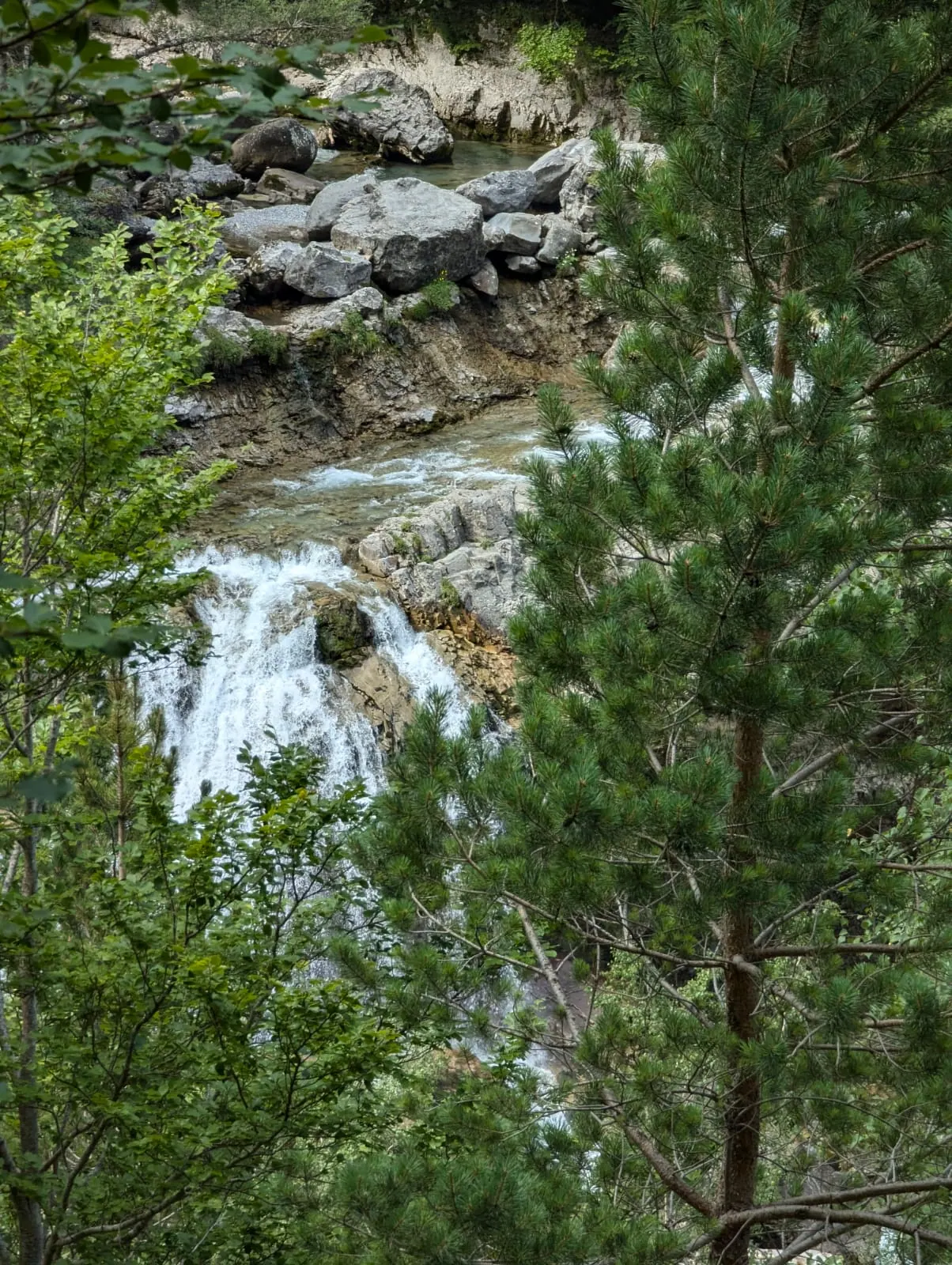
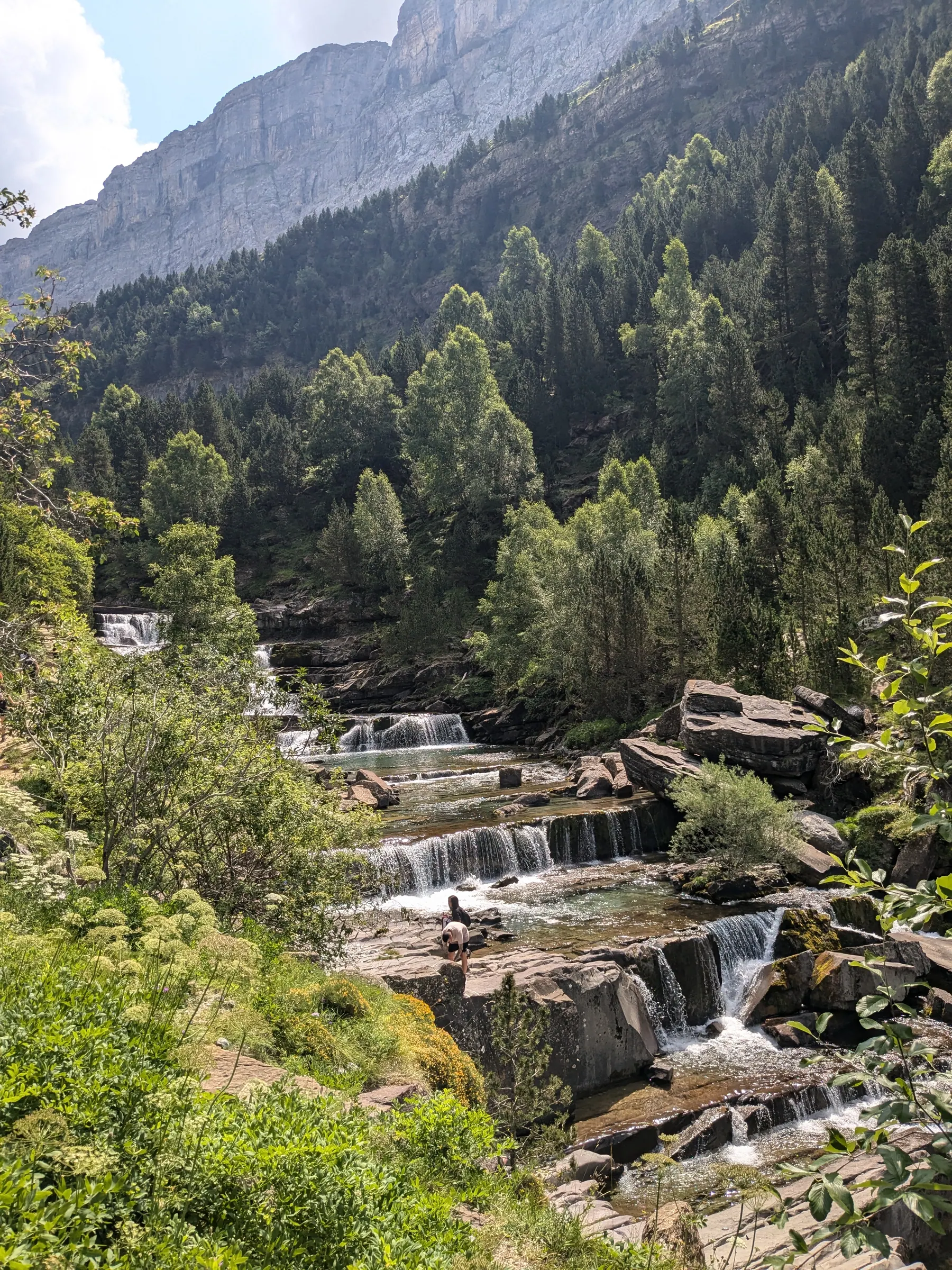
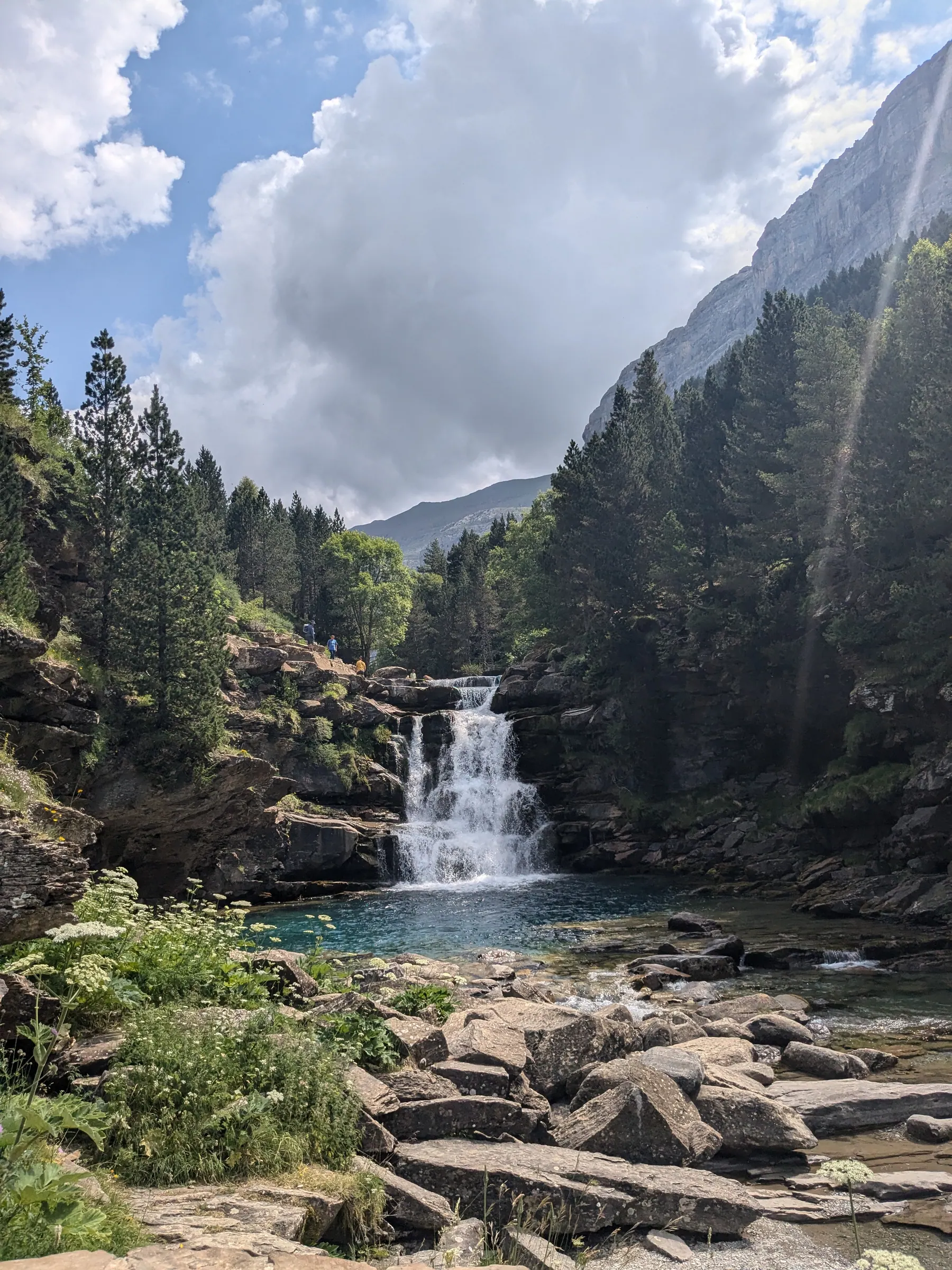
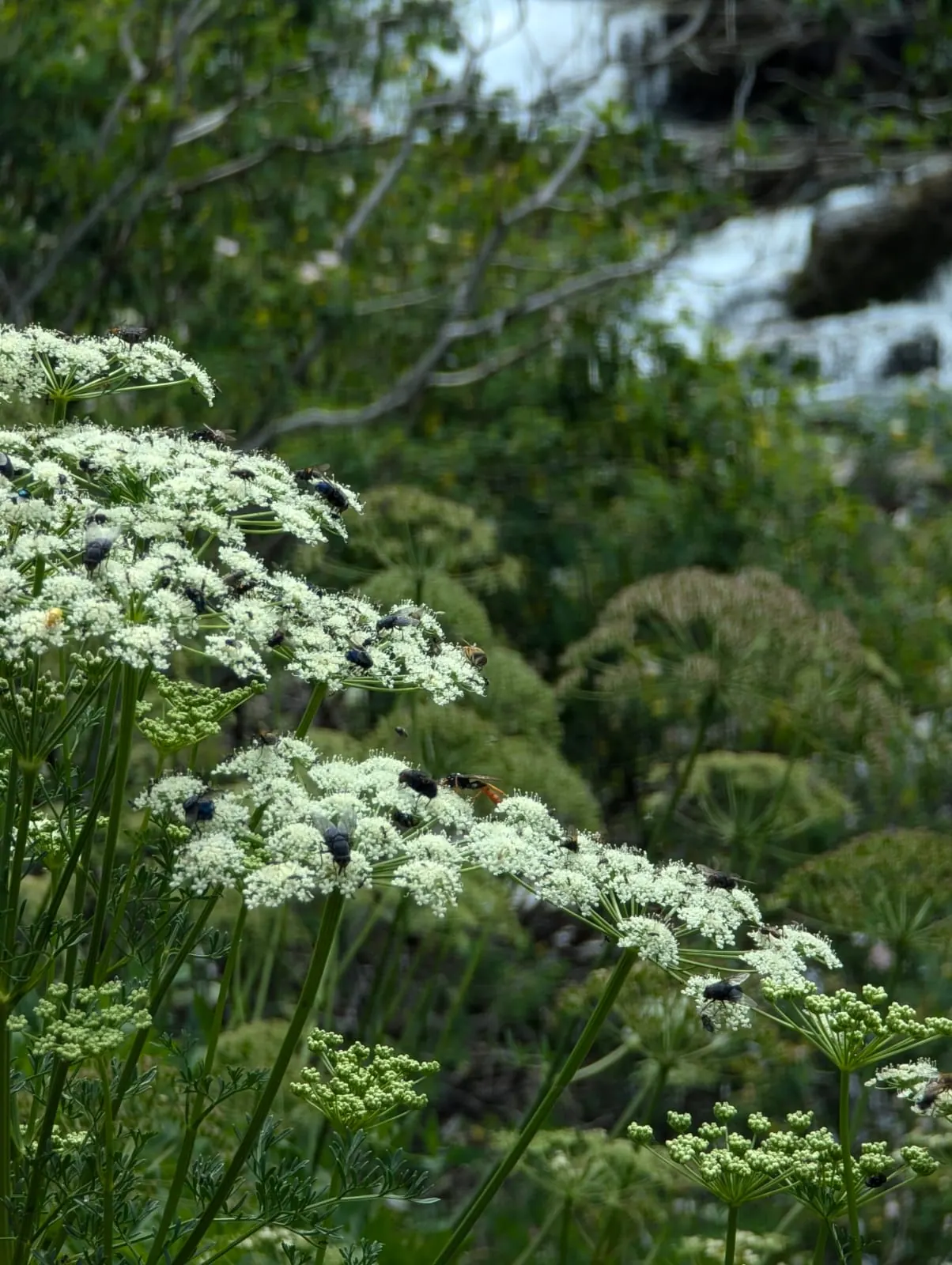
The walk isn’t steep. It’s the distance that tires you, which means it can be done with kids. You follow the river, passing small waterfalls, and at the very end you arrive at the Cola de Caballo - a very impressive waterfall at the head of the valley.
The name is fairly literal: Cola de Caballo means “horse’s tail”, referring to the shape of the falling water. The wider park’s name is just as evocative: Monte Perdido means “Lost Mountain”, traditionally linked to how the peak can seem hidden from the French side behind the surrounding summits. At 3,355 metres, it is one of the highest summits in the Pyrenees.
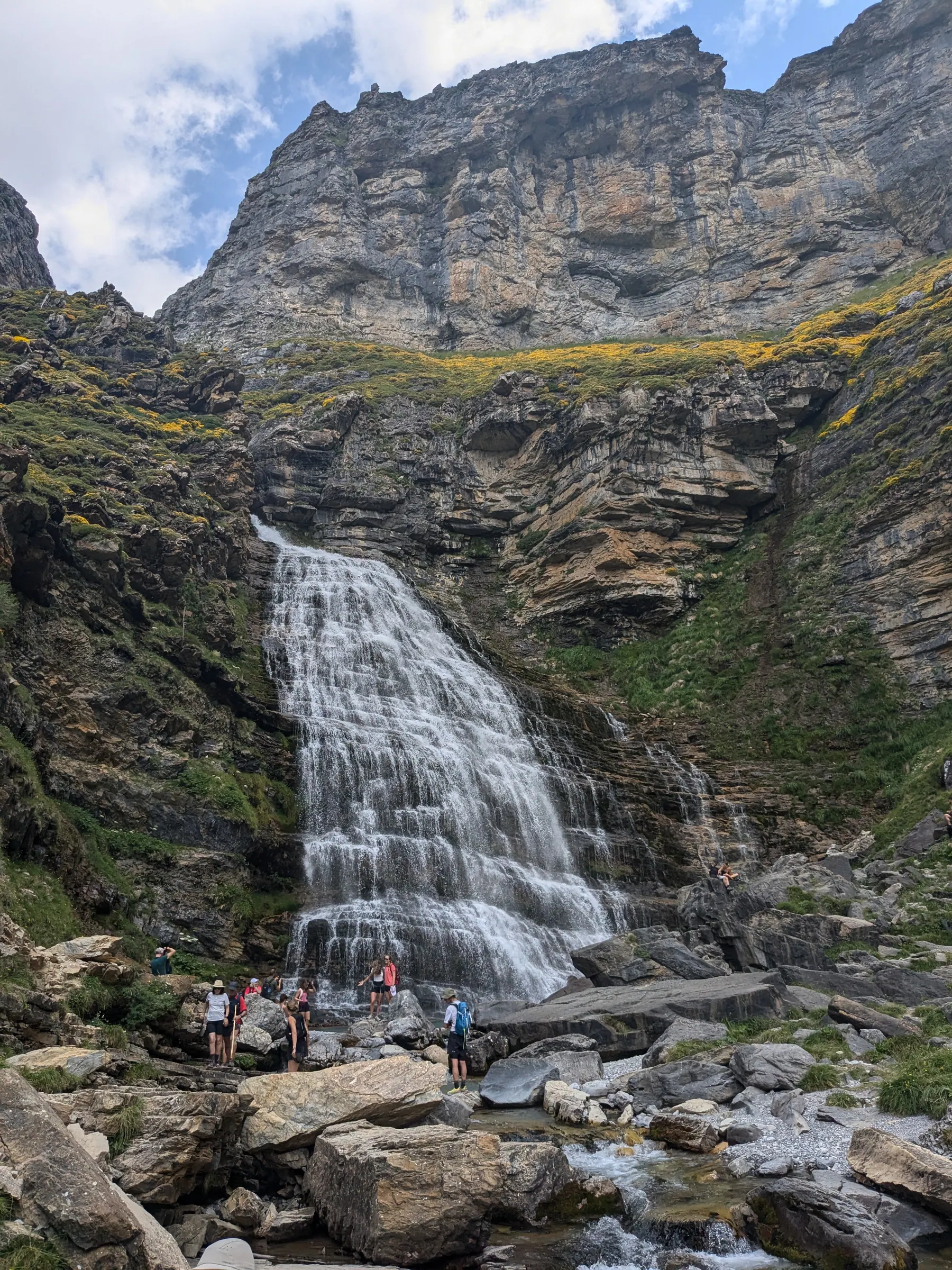
Now the honest part. In July, you share this path with a lot of people, and at the waterfall itself everyone converges at once. For a nature spot, it felt too crowded. That doesn’t mean skip it - the views are worth it, and I don’t think you can come to the Pyrenees without seeing Ordesa. Just know what you’re getting. We spent about five and a half hours there in total.
That said, I’m glad the shuttle bus exists, queue and all. Ordesa turns cars away in high season and caps how many people can be in the valley at once, because a landscape this fragile can’t absorb unlimited visitors without being ruined by its own popularity. Plenty of famous places learn that too late. Standing in the queue is a small price for a valley that’s still worth queueing for.
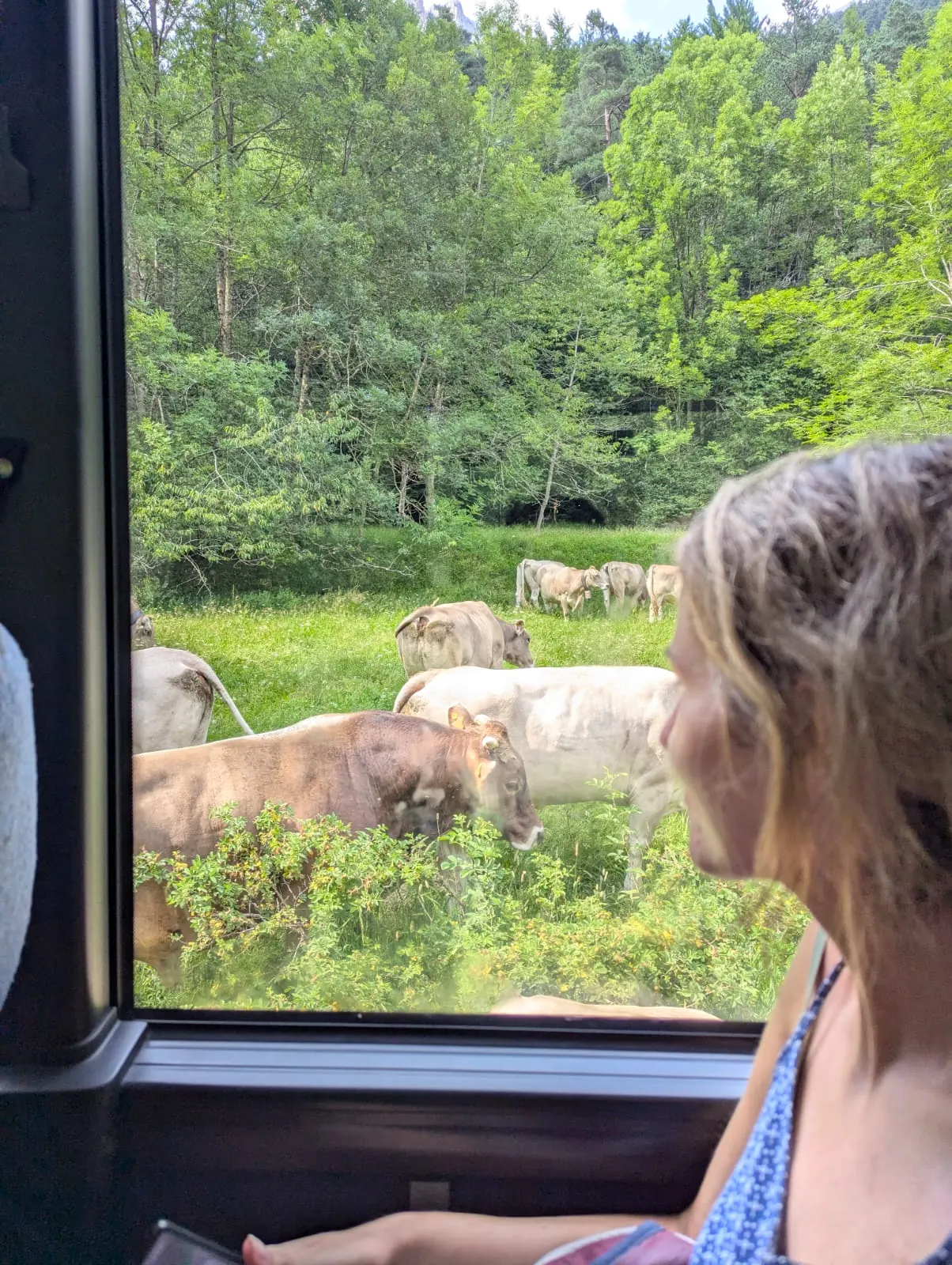
One thing that confused us at first, in case it helps: from the valley where the Cola de Caballo is, you can clearly see Monte Perdido rising much higher above you. But reaching Monte Perdido itself is a completely different and far more demanding route. We didn’t do it, and the standard Ordesa walk doesn’t take you there.
Afterwards we took the shuttle back to Torla and drove east to Castejón de Sos for the night. We had an excellent dinner at Restaurante Diamo, including the best homemade cheesecake I’ve ever eaten - it actually tasted of real mountain cheese.
Day 3: Slowing down in the Benasque valley
By the third day our legs had had enough, so we gave up on hiking and explored the Benasque valley instead.
We started in the town of Benasque itself, which is full of tourist apartments and houses, had a quick tapas, and took a photo with the town’s symbol - a goat.
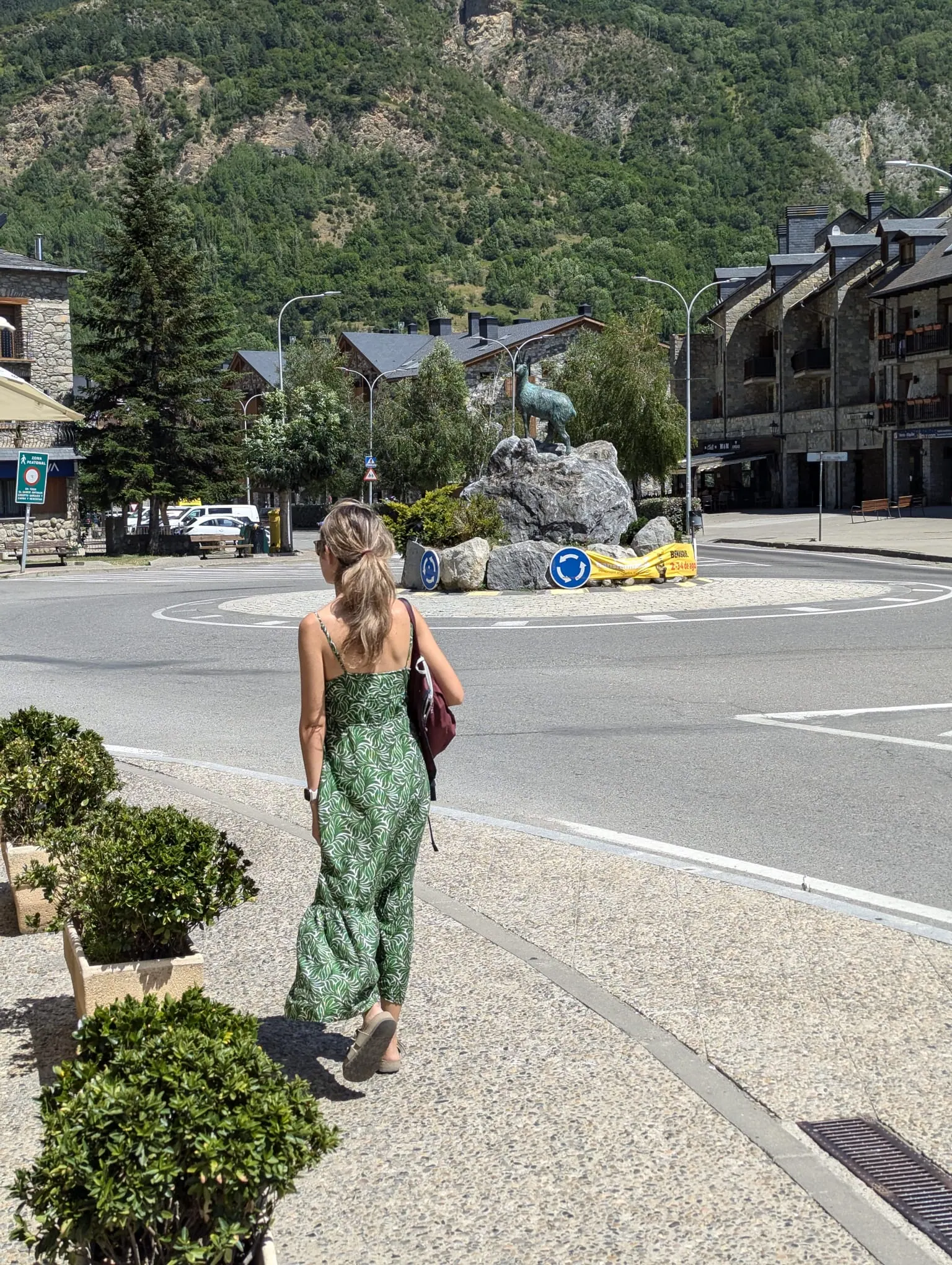
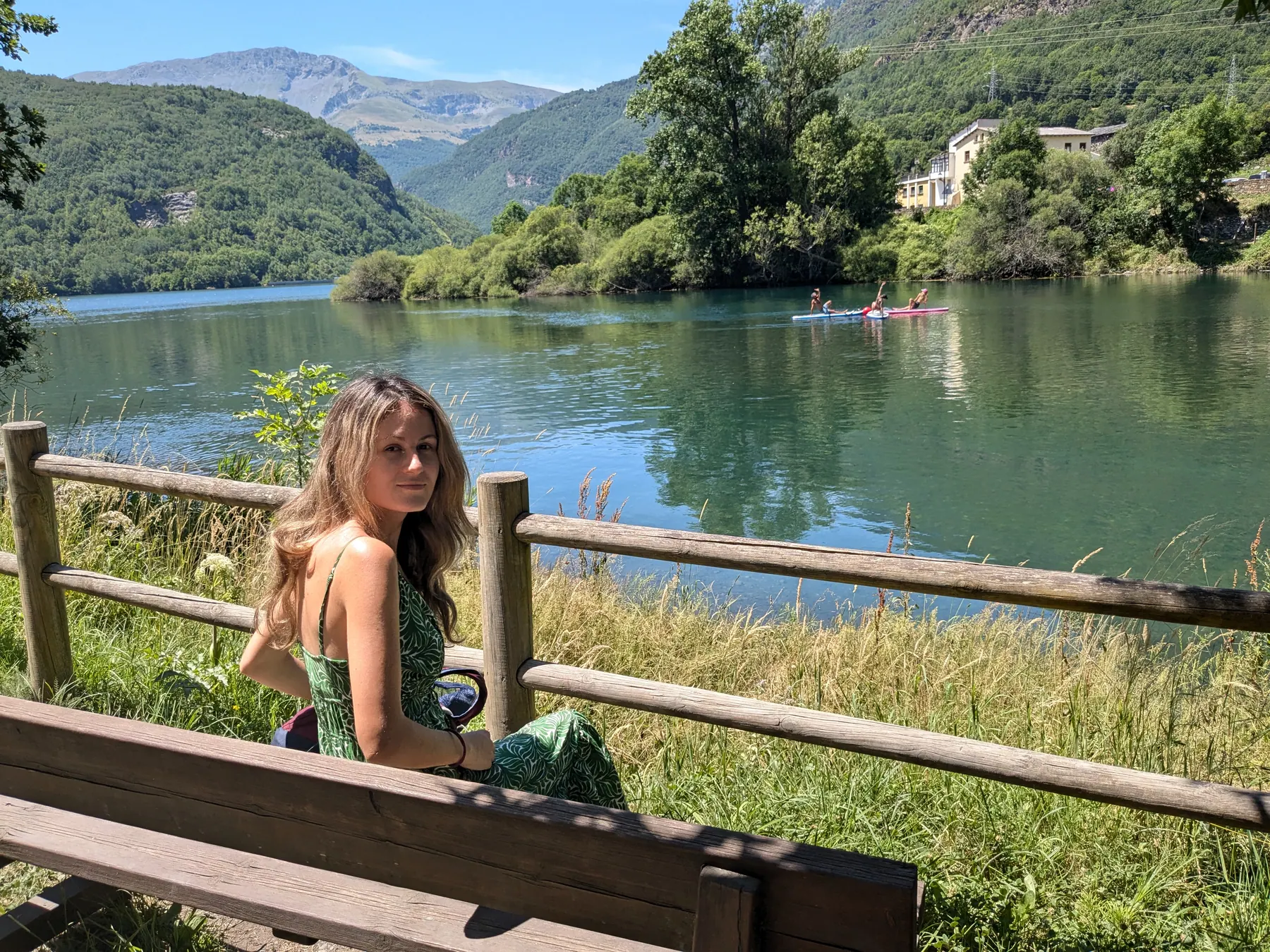
Then we stopped at the Embalse de Eriste, a beautiful artificial lake. People were out on small boats and kayaks, but we just walked around it. It’s a nice place to pause - maybe not worth a special journey, but if it’s on your route, stop.
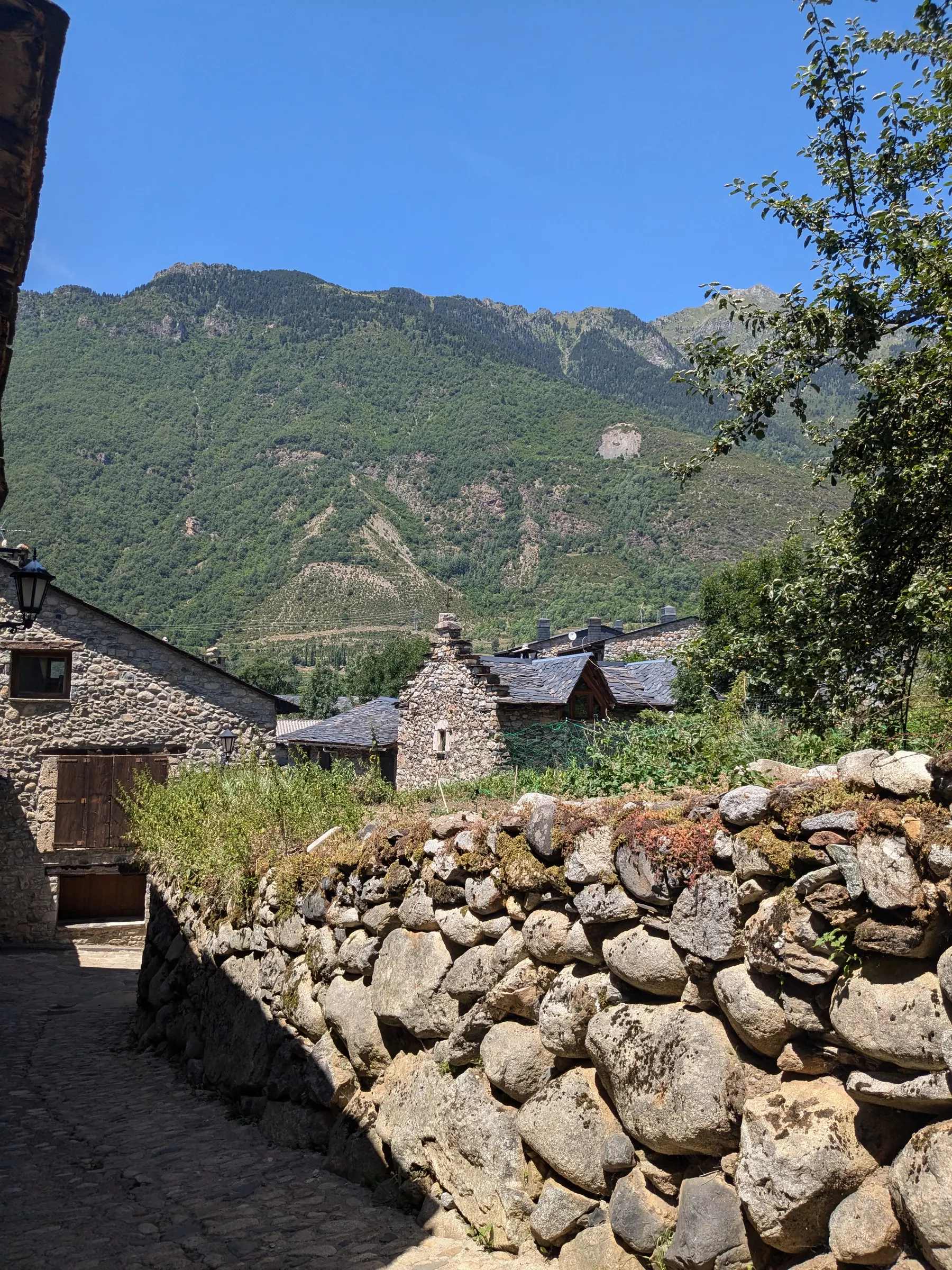
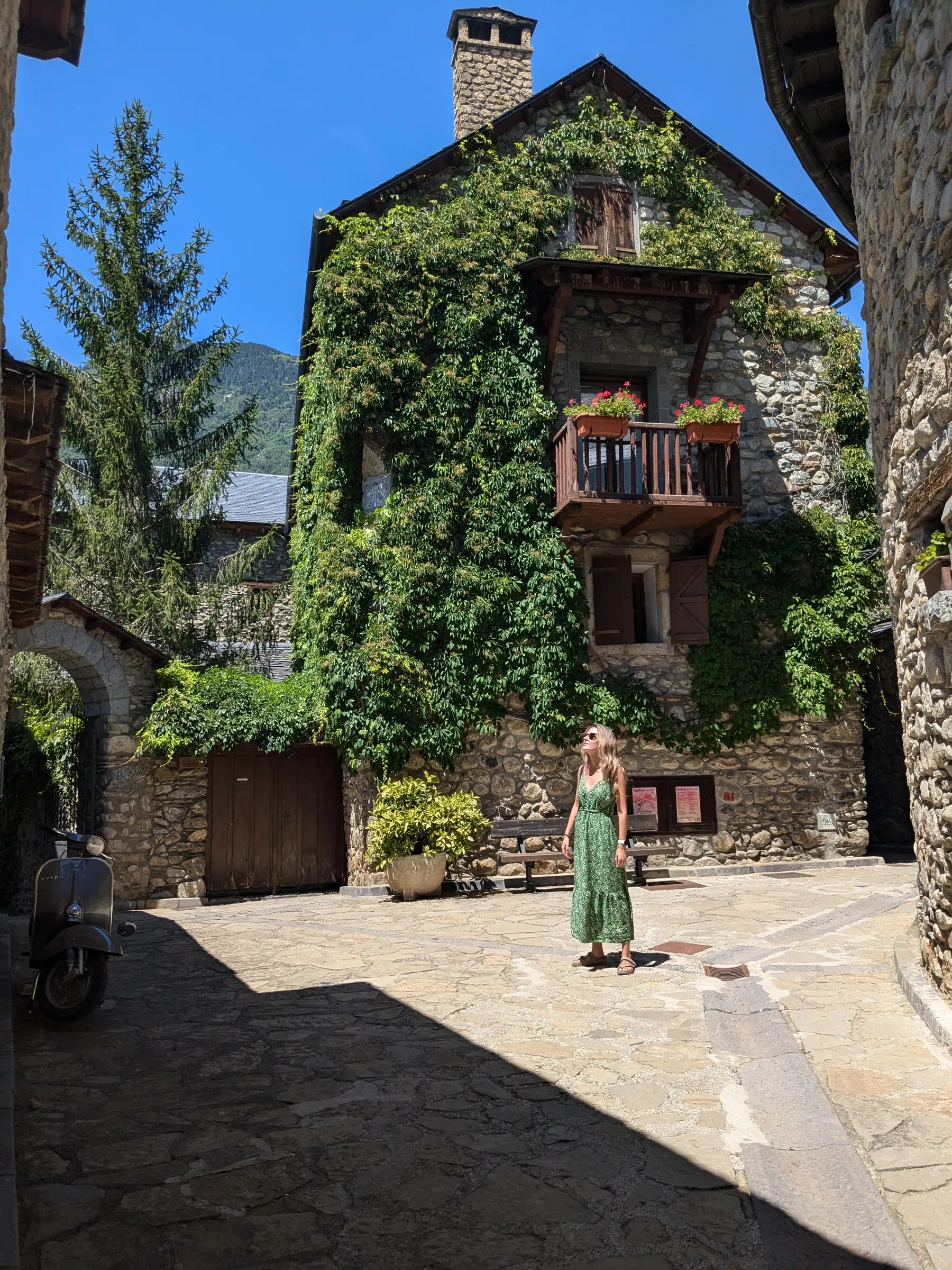
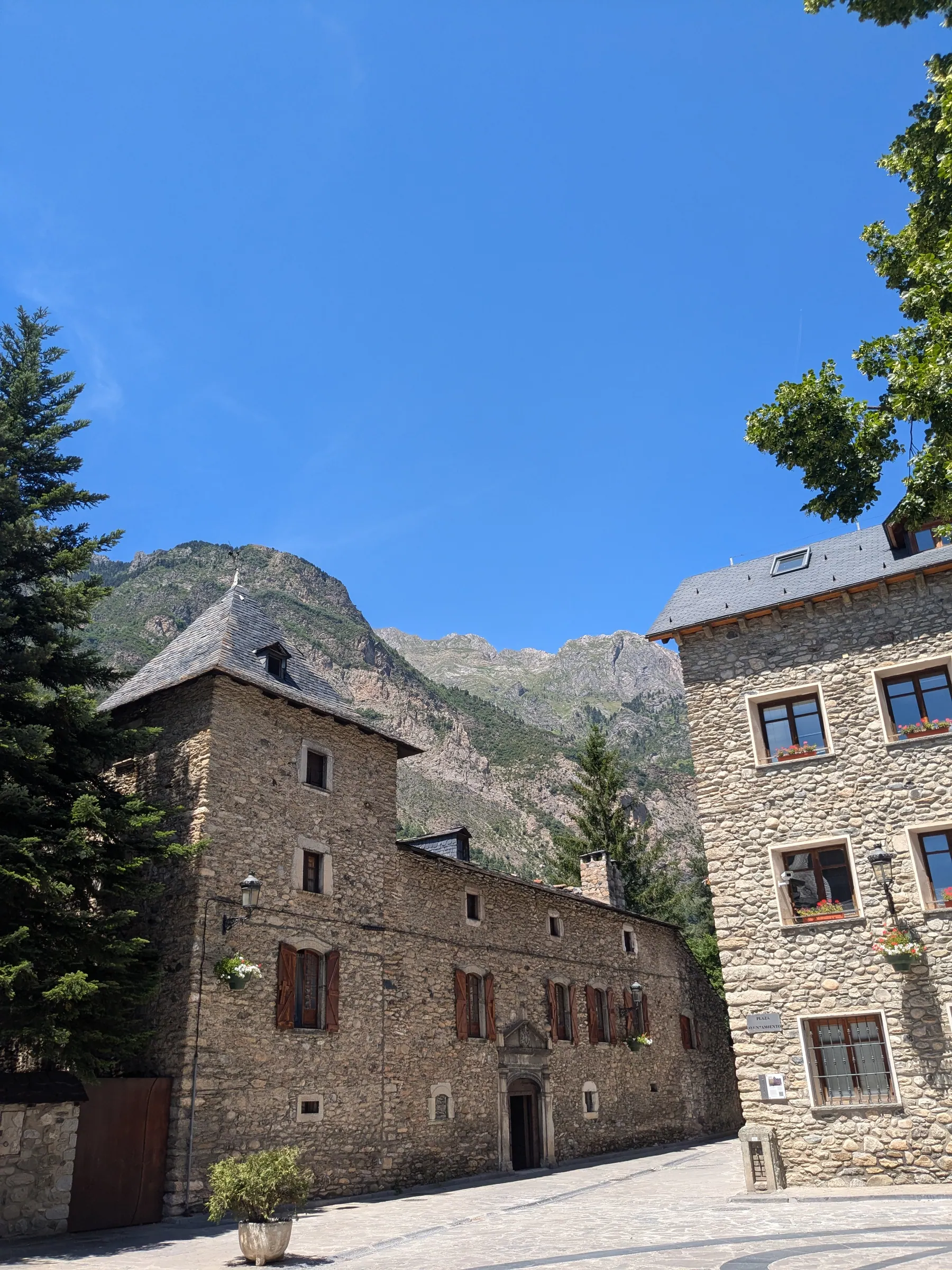
The best discovery came from a hotel receptionist’s recommendation: Anciles, a tiny village made almost entirely of stone, just a couple of kilometres from Benasque. It’s a real hidden gem, with a proper mountain-village atmosphere - narrow lanes, stone houses, slate roofs. Here’s the detail I liked: those grand stone mansions, built in the 16th and 17th centuries, went up because Benasque’s wealthy livestock owners chose to build their houses here, essentially to display their wealth. That’s why such a small place has such imposing houses, with carved eaves, big doorways and the stepped roofs typical of this valley.
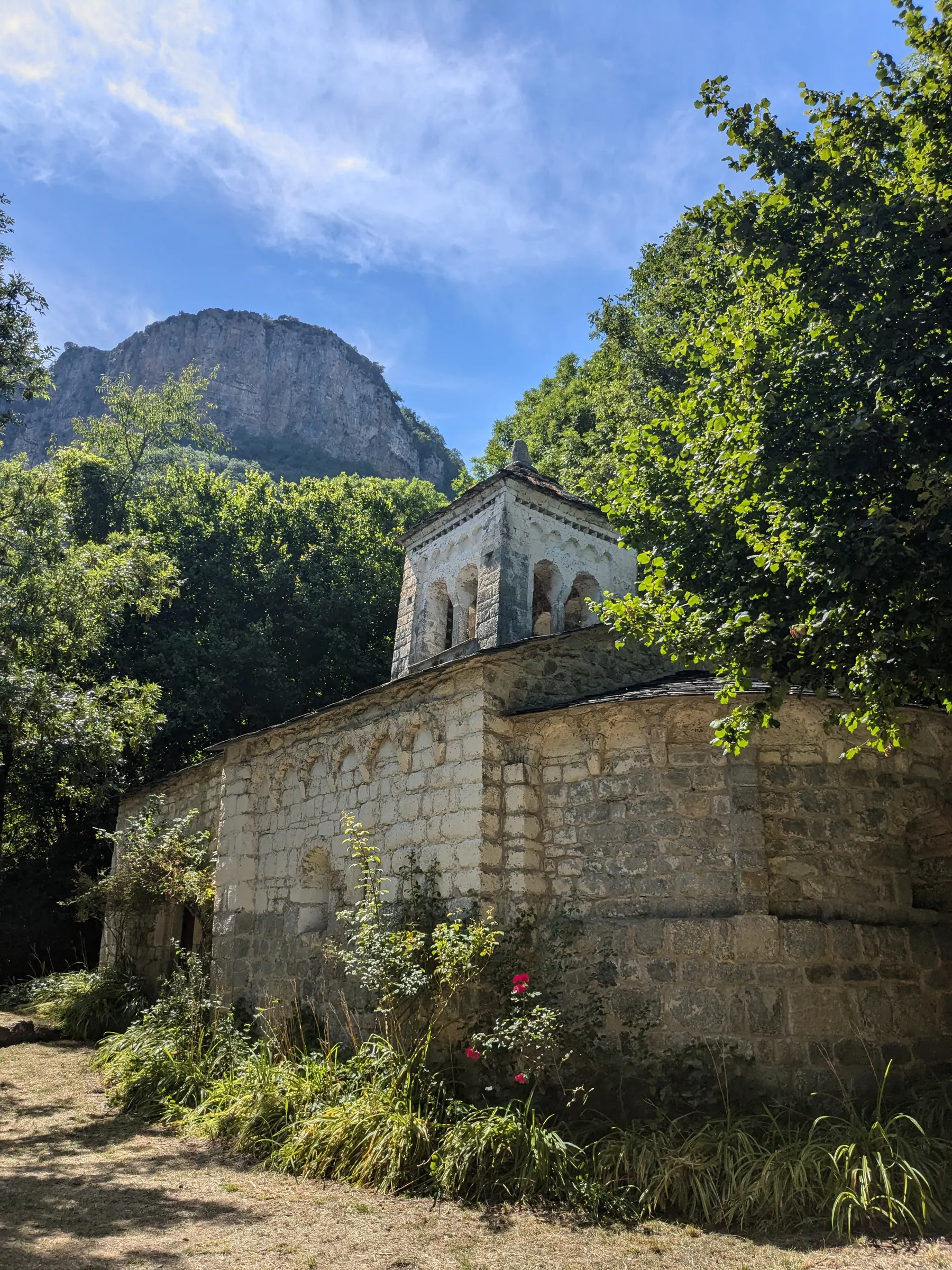
Near the village came the second recommendation: the Ermita de la Virgen de Gracia, an old hermitage sitting in the woods at the foot of the Sierra de Chía. It’s one of the best-preserved Romanesque buildings in the area, built in the Lombard Romanesque style, and it probably stands where it does because the old route through the Congosto de Ventamillo gorge passed nearby. But honestly, what caught us was the setting - walking through the trees and finding this small, old, beautiful thing standing alone in the middle of nature.
After that, we started the long drive home.
Know before you go
- You need a car for the region as a whole, but you can’t drive into Ordesa in high season - park in Torla-Ordesa and take the shuttle (about €4.50 return when we went; check current prices).
- Get to the shuttle early. We arrived at 9:00 and queued for 40 minutes. Earlier is better.
- There’s no entrance fee for Ordesa y Monte Perdido National Park.
- Summer is hot, even up here. We expected mountain coolness in July and didn’t get it. Start hikes early, and don’t underestimate open, shadeless stretches like the Valle de Otal.
- Carry more water than you think you need, especially for Otal.
- Both main hikes are long rather than difficult. Neither is technical, and Ordesa can be done with children - but distance and sun will tire you.
- Don’t confuse Monte Perdido with the Ordesa walk. Seeing the peak is not the same as climbing it; that’s a much harder route.
- Bases: Torla-Ordesa is ideal for Ordesa and Otal. Castejón de Sos or Benasque work for the Benasque valley, which is a couple of hours further east.
Two hikes, two mountains
If I had to sum up the Aragonese Pyrenees from three days there, it’s this: the same mountains can give you two completely different experiences. Ordesa is spectacular and unmissable, and you’ll share it with a crowd. Valle de Otal is just as beautiful and far quieter, and it gave us the moment I’ll actually remember - a long stretch of valley with nobody in it but us.
Do both. But if you only have the energy for one, think about which of those two things you’re really looking for.
With a little more time, I would add a few nearby detours to this route. In the Ordesa area, Añisclo Canyon and Pineta Valley are the obvious next choices, both offering a different side of the national park. Around Benasque, the Posets-Maladeta Natural Park, Llanos del Hospital and the easy walk to Forau de Aigualluts would take you further into the high mountains. And if you want a slower cultural stop between the valleys, Aínsa is the kind of stone-built town that deserves a few hours. We didn’t fit all of that into three days, but it is exactly why I would happily come back.
And beyond the hikes, this is a place to properly immerse yourself in nature. Between the walks there are small stone villages where it feels like time has stopped, and days that slow you right down. Coming from a big city, it worked as a kind of detox. If you like slow travel - few plans, long walks, quiet places, no rush - the Pyrenees are made for it.
FAQs
Are the Aragonese Pyrenees worth visiting in summer?
Yes, especially if you want dramatic mountain scenery and hiking. Keep in mind that July is hot and Ordesa gets busy.
Do you need a car to visit Ordesa and the Benasque valley?
Yes. You need a car to get around the region, though in high season you leave it in Torla-Ordesa and take the mandatory shuttle bus into Ordesa national park.
Which hike is better, Ordesa or Valle de Otal?
Ordesa is more dramatic and famous, but also much busier. Valle de Otal is just as scenic and far quieter.
Read next
More posts for this trip mood
 Europe
 Aragón, Spain
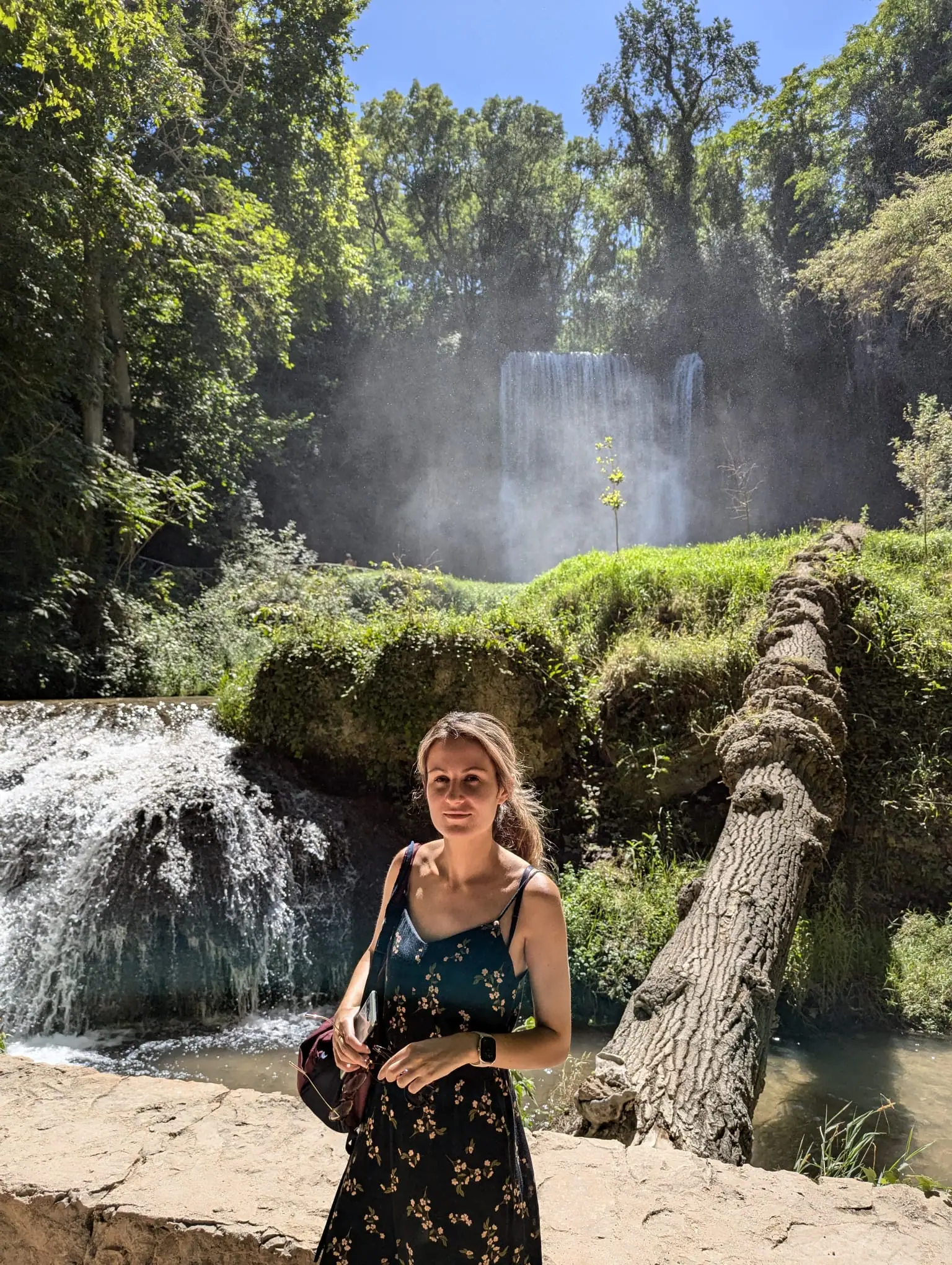
Monasterio de Piedra: A Fairytale Waterfall Park to Escape the Summer Heat
A hidden waterfall detour that feels like a small paradise in dry Aragón.
A summer visit to Monasterio de Piedra in Aragón, Spain, with waterfalls, caves, monastery history, practical tips and why it is worth the detour from Zaragoza.
 Europe
 Balearic Islands, Spain
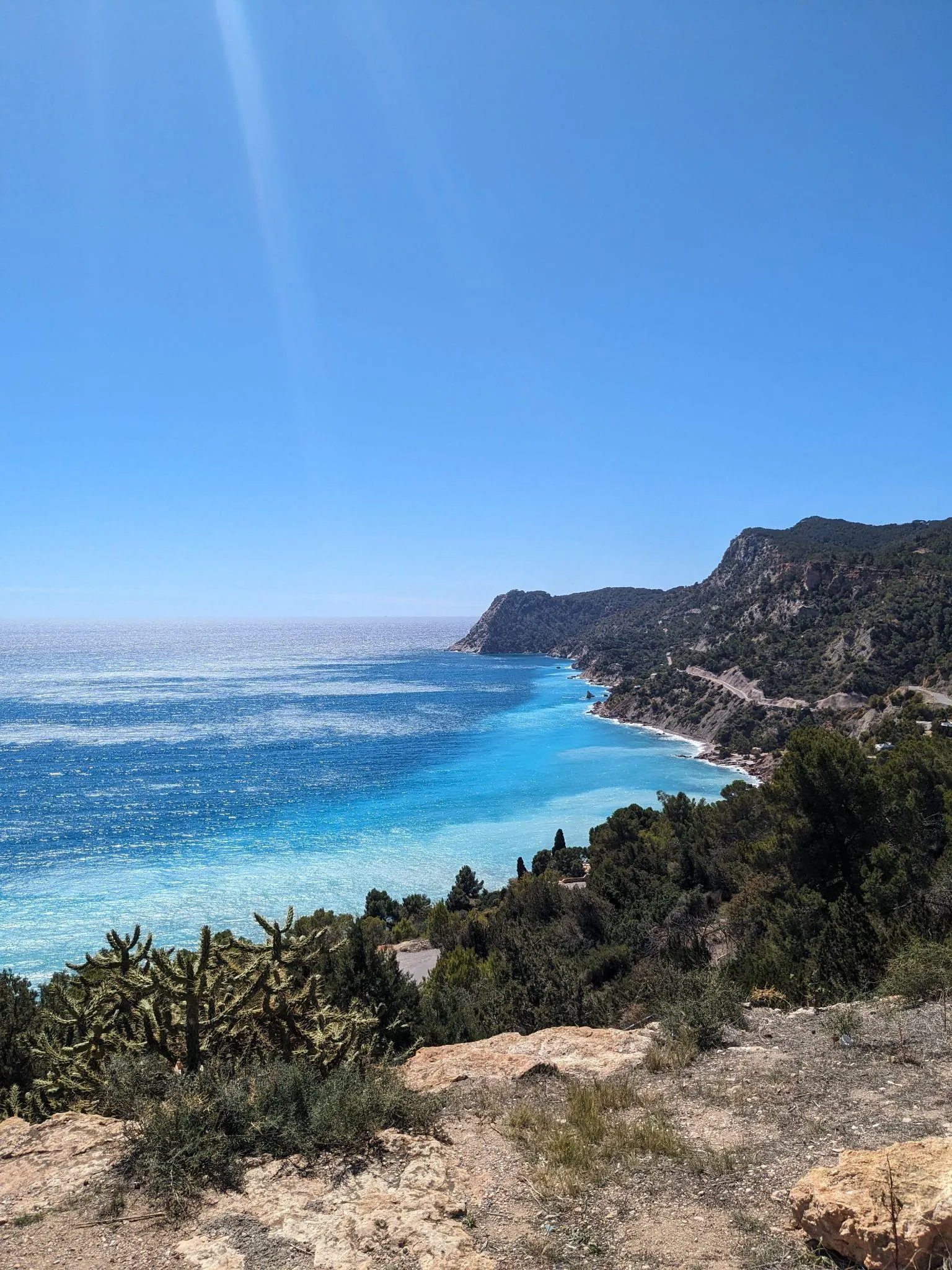
Things to Do in Ibiza Off-Season: Nature, Empty Calas & 4-Day Route
Ibiza off-season is a completely different island: empty calas, quiet hiking trails, and dramatic coastal views without the summer rush.
A 4-day off-season Ibiza guide focused on nature, empty calas, coastal hikes, Dalt Vila, Es Vedrà, and practical April road trip tips.
 Europe
 Canary Islands, Spain
Gran Canaria Beyond the Beach Holiday: A Miniature Continent
Gran Canaria is far more than its beaches: a week of cloud forest, volcanic mountains, quiet villages and Atlantic coast.
A week exploring Gran Canaria beyond the resorts, from Agaete and Las Palmas to Roque Nublo, Artenara, Maspalomas and Barranco de las Vacas.