

Bardenas Reales · Navarra · Spain
Bardenas Reales: Spain's Otherworldly Desert in Navarra
A strange, cinematic desert stop that makes Spain feel like another planet.
A practical guide to visiting Bardenas Reales in Navarra, Spain, with Castildetierra, the main driving loop, desert landscapes, heat advice, where to stay and tips for planning a road trip.
Quick facts
- Best for
- Desert landscapes, road trips, unusual rock formations, photography and a very different side of Spain.
- Time needed
- Around two hours for the main driving loop with stops.
- Getting there
- Best by car from Arguedas or Tudela; Zaragoza and Pamplona are both roughly one to one and a half hours away.
- Good to know
- There is almost no shade, no shops and no water inside the park. Avoid the middle of a hot summer day.
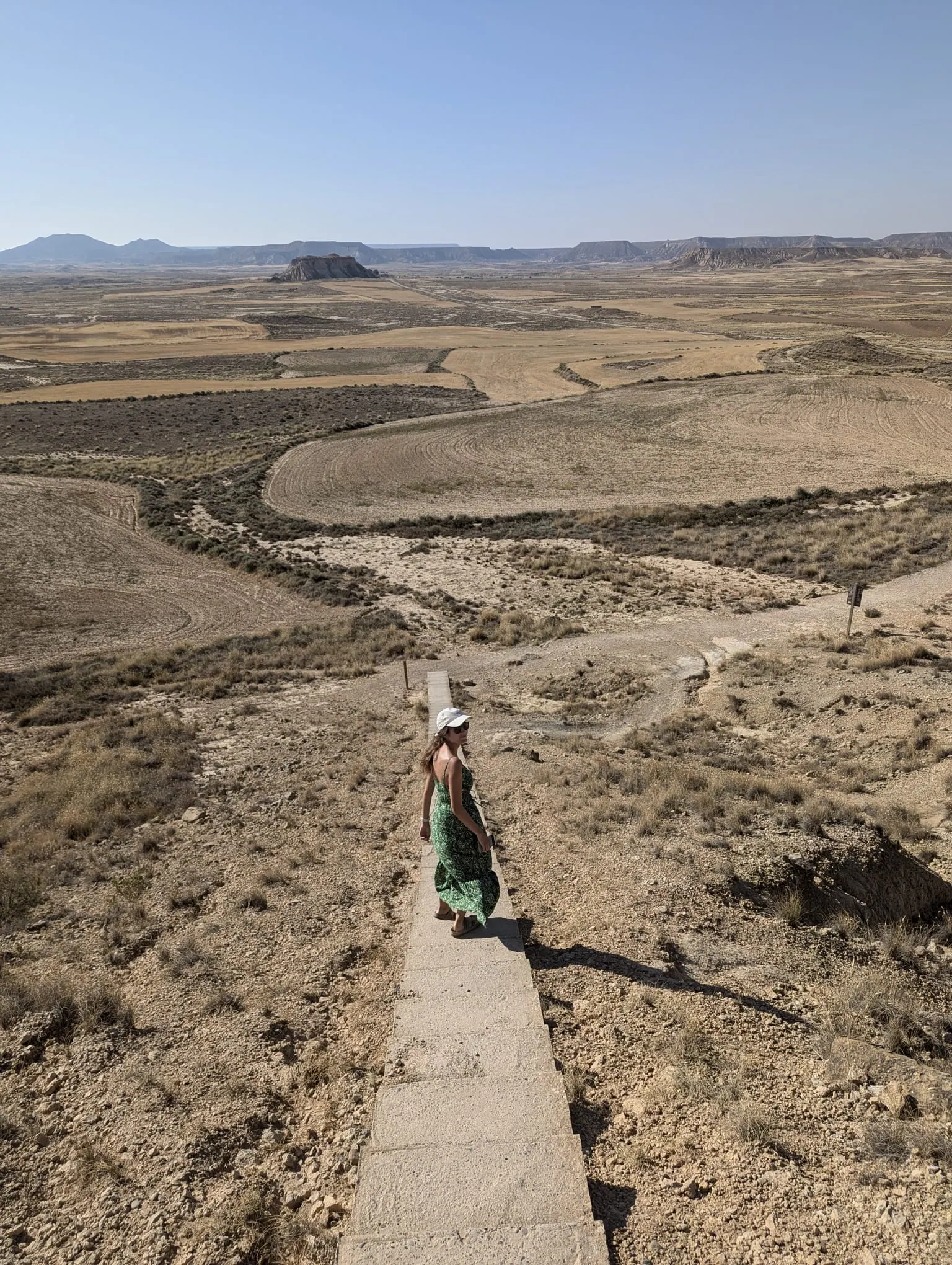
The day before, we had been walking through the green, dripping waterfalls of Monasterio de Piedra. The next morning we drove into Bardenas Reales, and it was like landing on a different planet. One day, a cool water park full of caves and cascades. The next, a bare, orange-yellow desert stretching out in every direction. Spain does not usually look like this, and that contrast is exactly why Bardenas stuck with me. It was the first stop on our trip to the Aragonese Pyrenees.
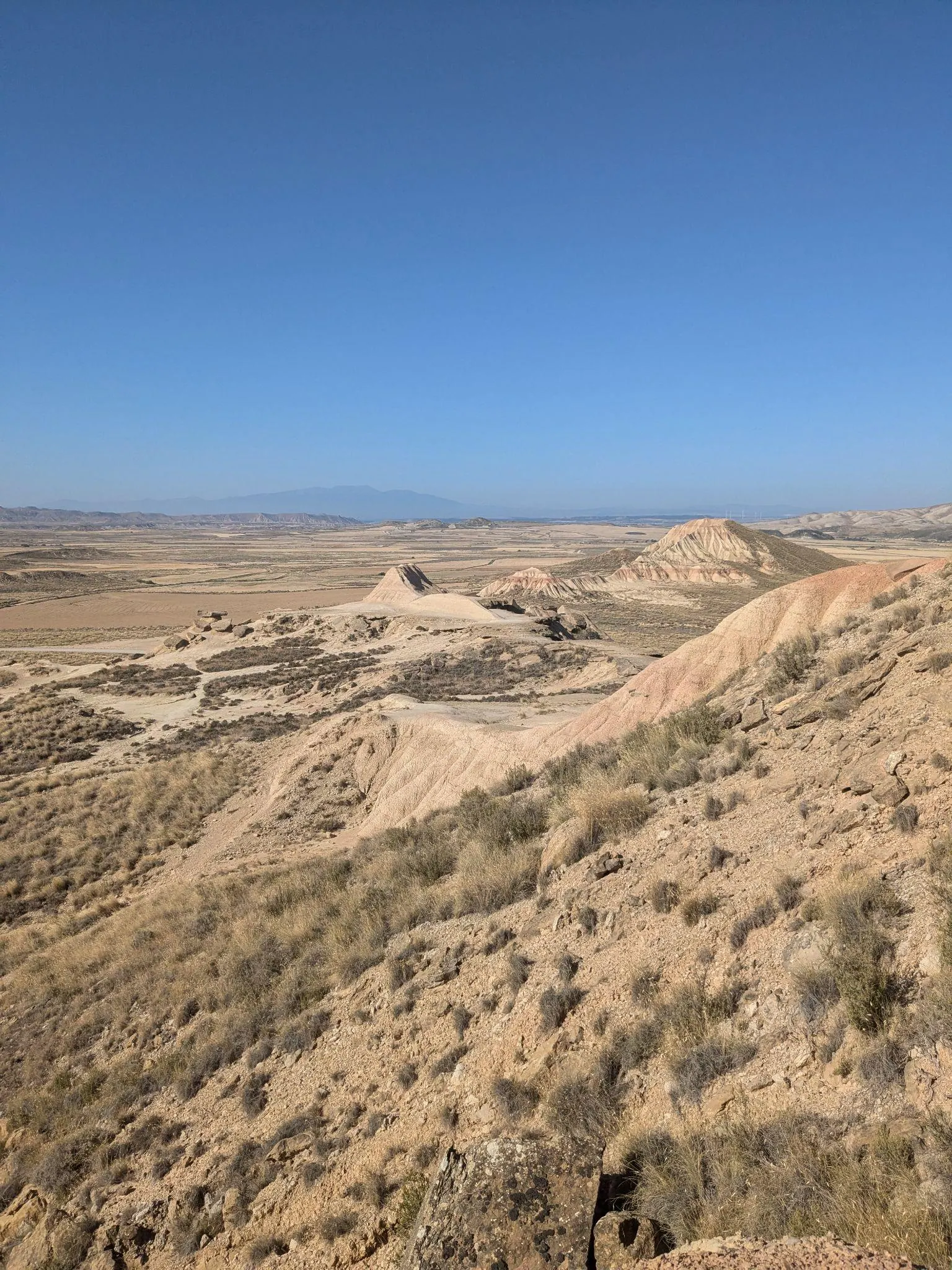
It does not feel Spanish at all. Everywhere you turn there are strange rock formations, like small worn-down mountain ranges, all in shades of orange and yellow, and it seems to go on forever. Some of the shapes are odd enough that your imagination starts filling in what they look like. It felt, more than anything, like stepping into a different world.
What it is, and where
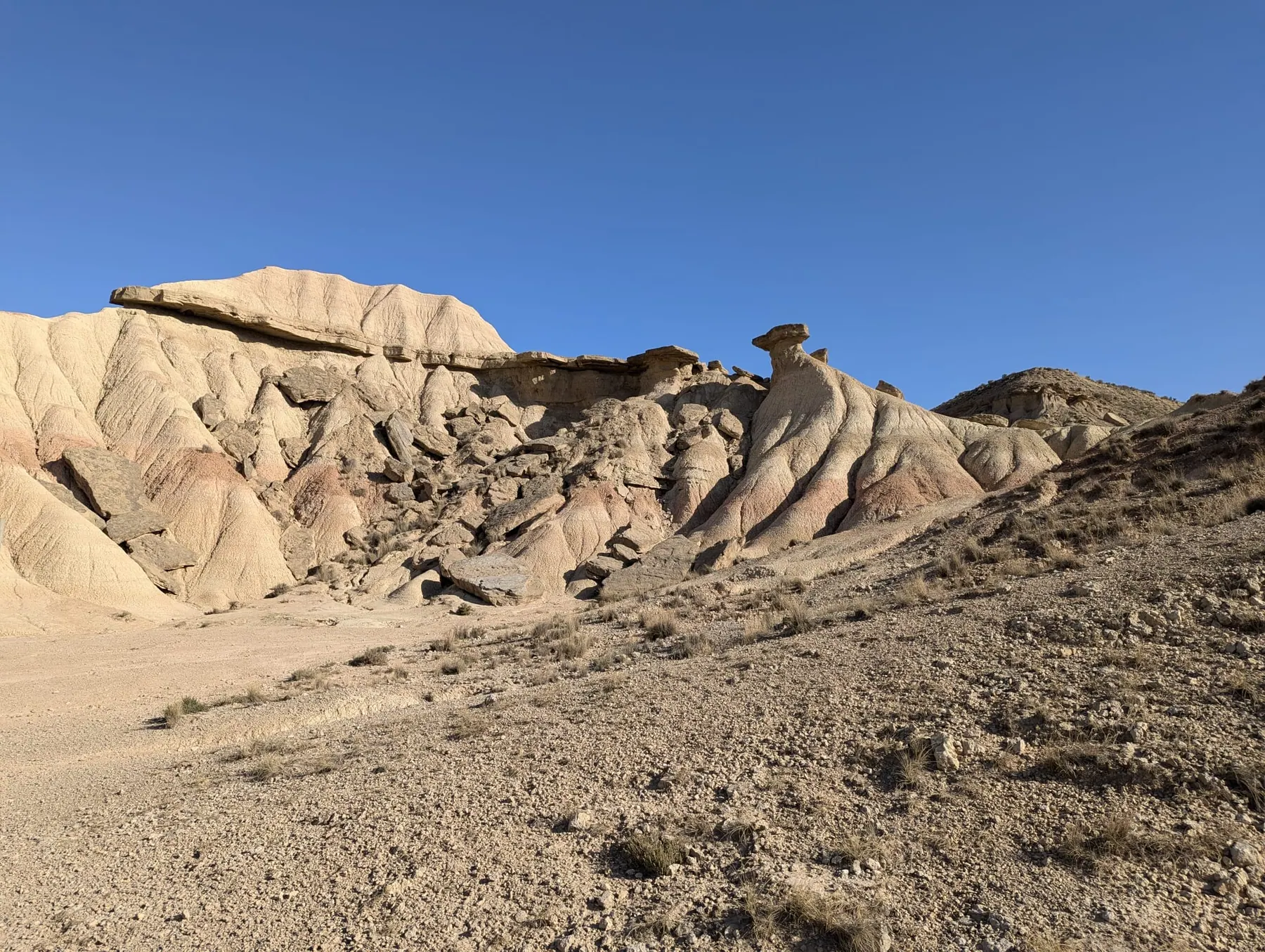
Bardenas Reales is a semi-desert in the southeast of Navarra, in northern Spain, right on the border with Aragon. It covers around 42,000 hectares. There are no towns inside it - the land is used for grazing, and, strangely, part of it is a military firing range (more on that below).
The area is usually split into three parts, but the one everyone comes for is La Bardena Blanca - the whitest, most eroded, most photographed section, and the one with the famous rock formations. The main gateway is the town of Arguedas, which is also where we stayed, at a rural guesthouse called Casa Rural La Bardena Blanca.
It’s also easy to fit into a trip. Bardenas sits within about an hour to 90 minutes of both Zaragoza and Pamplona, so it works best as a stop on a road trip through northern Spain rather than somewhere you travel to on its own.
How this desert got here
It helps to know why a place like this exists in the middle of Spain. Long ago, when the Pyrenees and the other mountains around here were pushed up, they trapped a huge closed basin between them with no way out to the sea - basically a giant inland lake. For millions of years, rivers washed soft clay, gypsum and sandstone down from those mountains and left it in thick layers on the bottom.
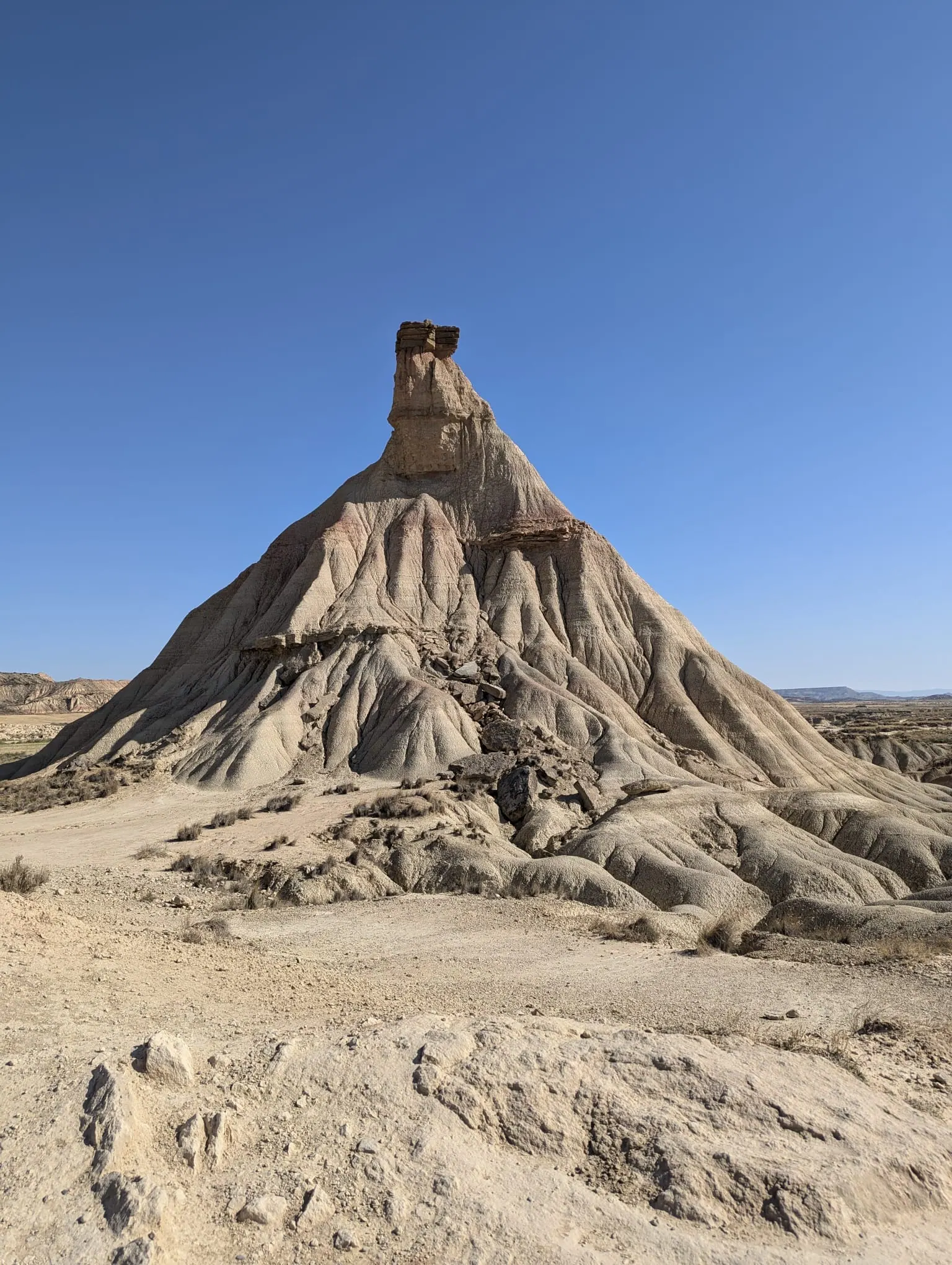
Then, around ten million years ago, the basin finally opened towards the Mediterranean and drained, and the River Ebro was born. From that point on, wind and rain went to work on all that soft rock, slowly carving it into the ravines, the flat-topped hills and the lonely rock towers you see today. Where a harder layer sits on top, it protects the softer rock underneath - which is exactly why formations like Castildetierra end up so tall and top-heavy.
The strange part is that it still isn’t finished. The landscape is eroding all the time, new gullies appear after heavy rain, and one day these shapes will wear away completely. So you’re really looking at a work in progress - which is also why it’s so fragile, and why you’re asked to stay on the tracks and not climb on the formations.
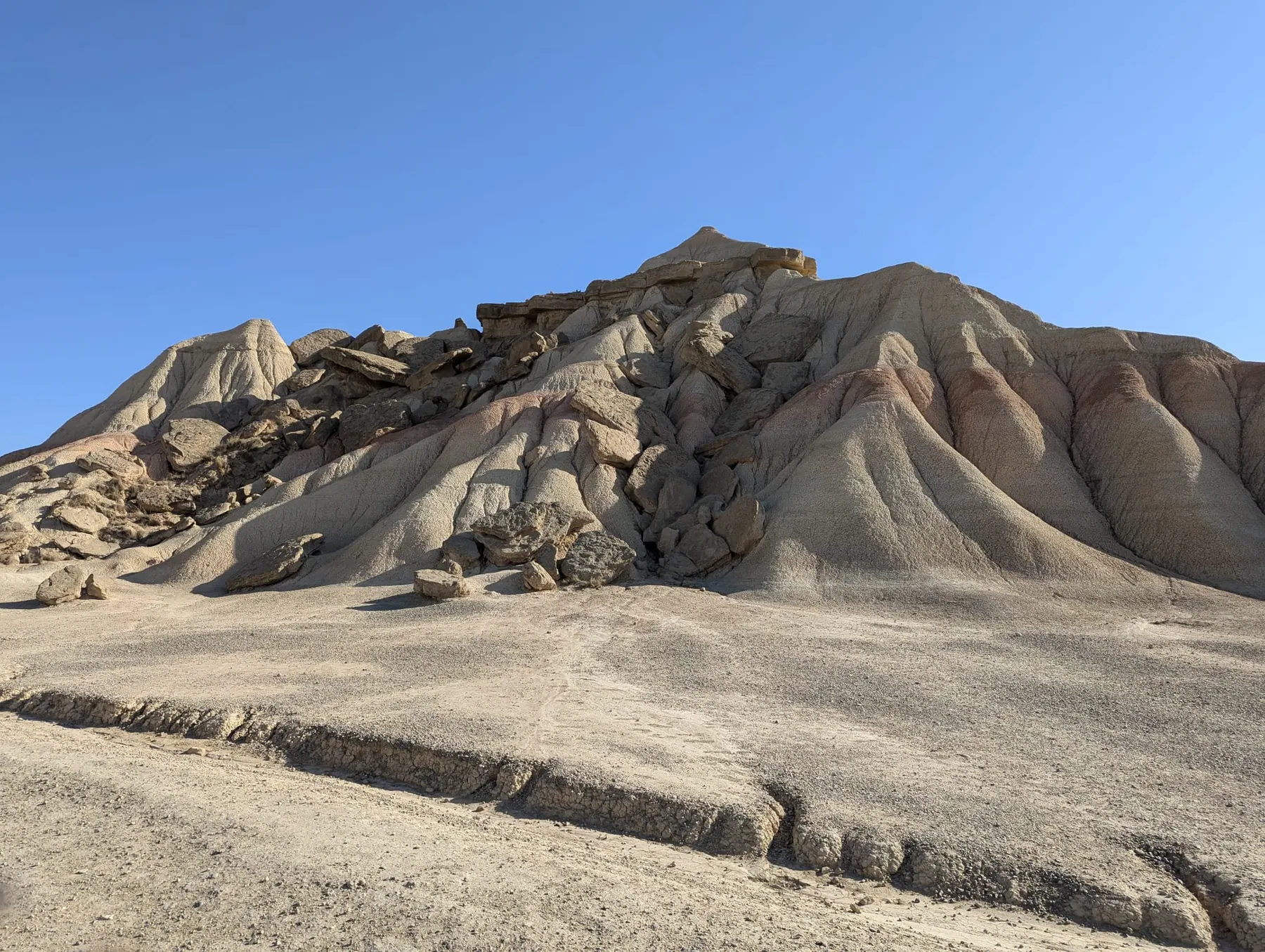
More than empty desert
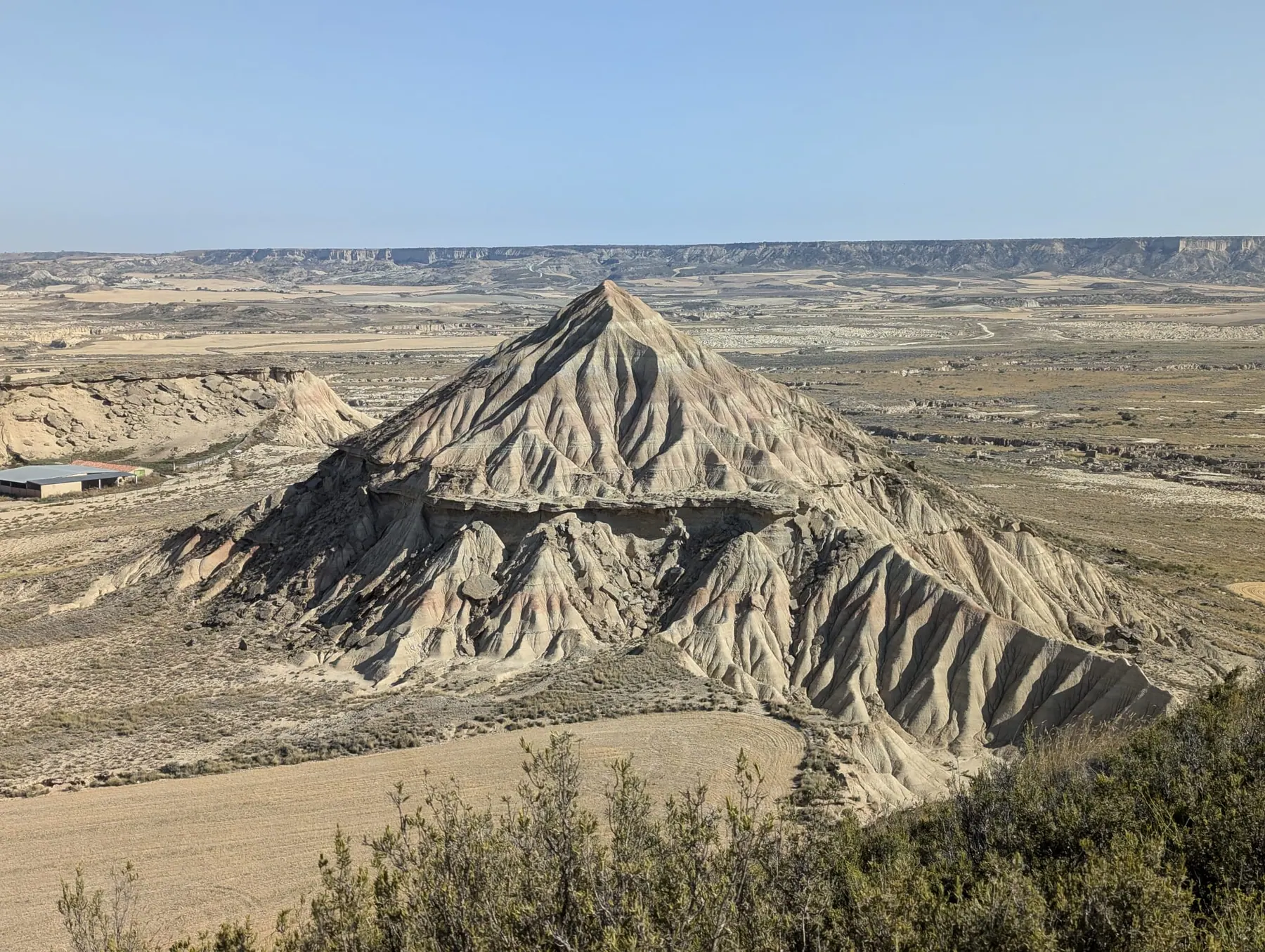
It’s easy to write Bardenas off as a lifeless place, but it’s actually a protected natural area and a UNESCO Biosphere Reserve. It earned that status partly because the landscape is so rare, and partly because it’s a fragile ecosystem that damages easily.
And it isn’t as empty as it looks. Plants and animals do survive out here, though they feel more African than northern Spanish - birds of prey like vultures, eagles and owls ride the air currents above the formations. Its past was wilder still: millions of years ago, when the climate was much wetter, this land was home to crocodiles and tortoises.
Seeing it: a drive, not a walk
The most important practical thing to know is that Bardenas is big, and you see it by car, stopping often. This is not a place you wander around on foot in the heat - everyone there was driving, and so were we. The main route is a loop of around 30 kilometres on dirt tracks that takes about two hours with stops. A normal car is completely fine for it; you do not need a 4x4.
We drove it ourselves, with no guide, stopping wherever something caught our eye, and spent roughly two hours inside. At one point we drove quite far out and reached the edge of the military zone, where you simply have to turn around and head back. It is an odd feeling - a nature reserve and biosphere on one hand, an army firing range on the other, sharing the same desert.
One stop that stuck with me was the Monument to the Shepherd (Monumento al Pastor), standing alone out in the open - a simple tribute to the shepherds who have brought their flocks to graze this land for centuries.
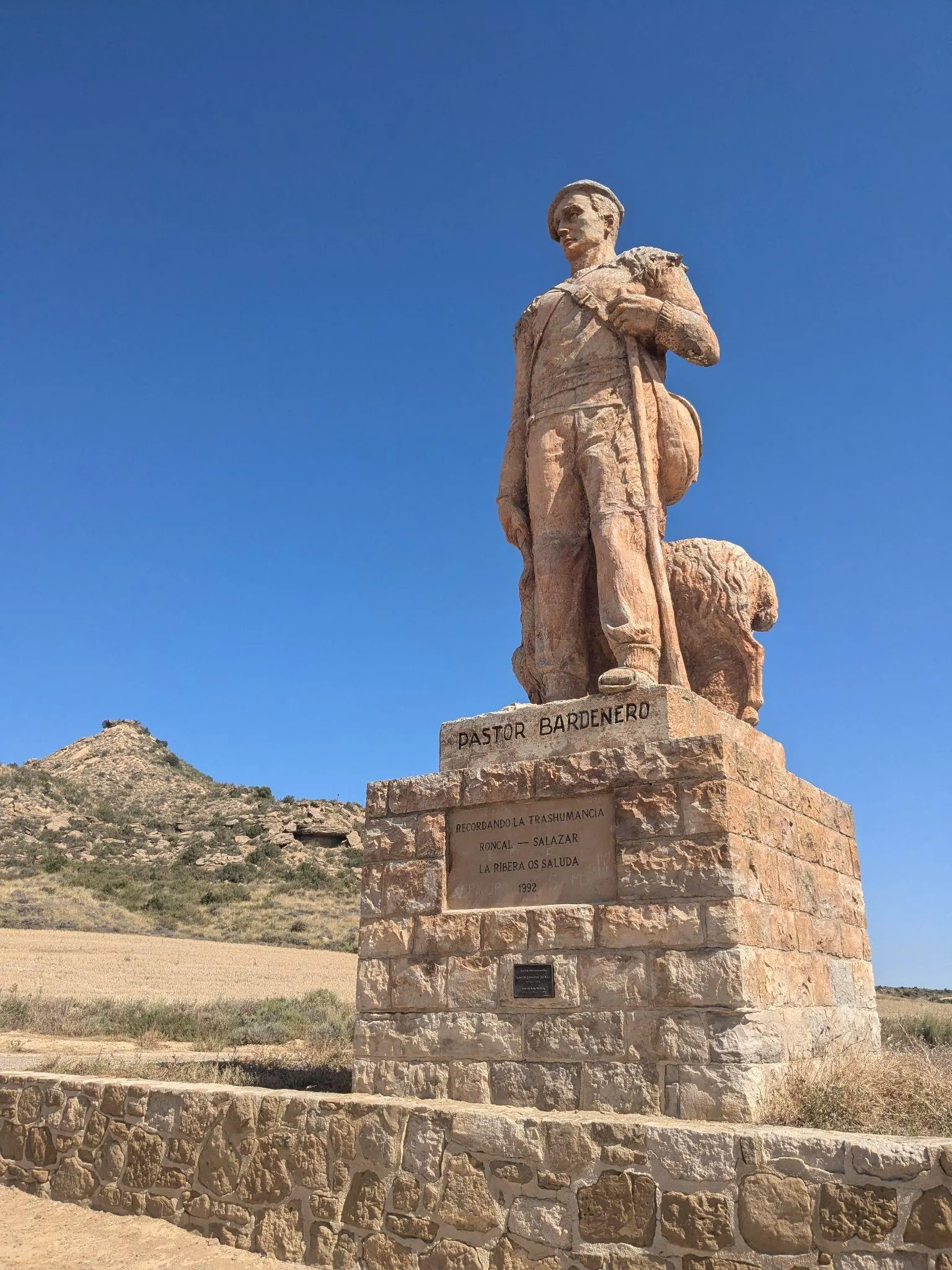
If you’d rather not drive it yourself, there are other ways to explore - guided 4x4 tours, buggies, bikes, even sunrise balloon rides. And if you have more time, there’s more than the main loop: other viewpoints across the park, and the greener, quieter Bardena Negra in the south.
Castildetierra
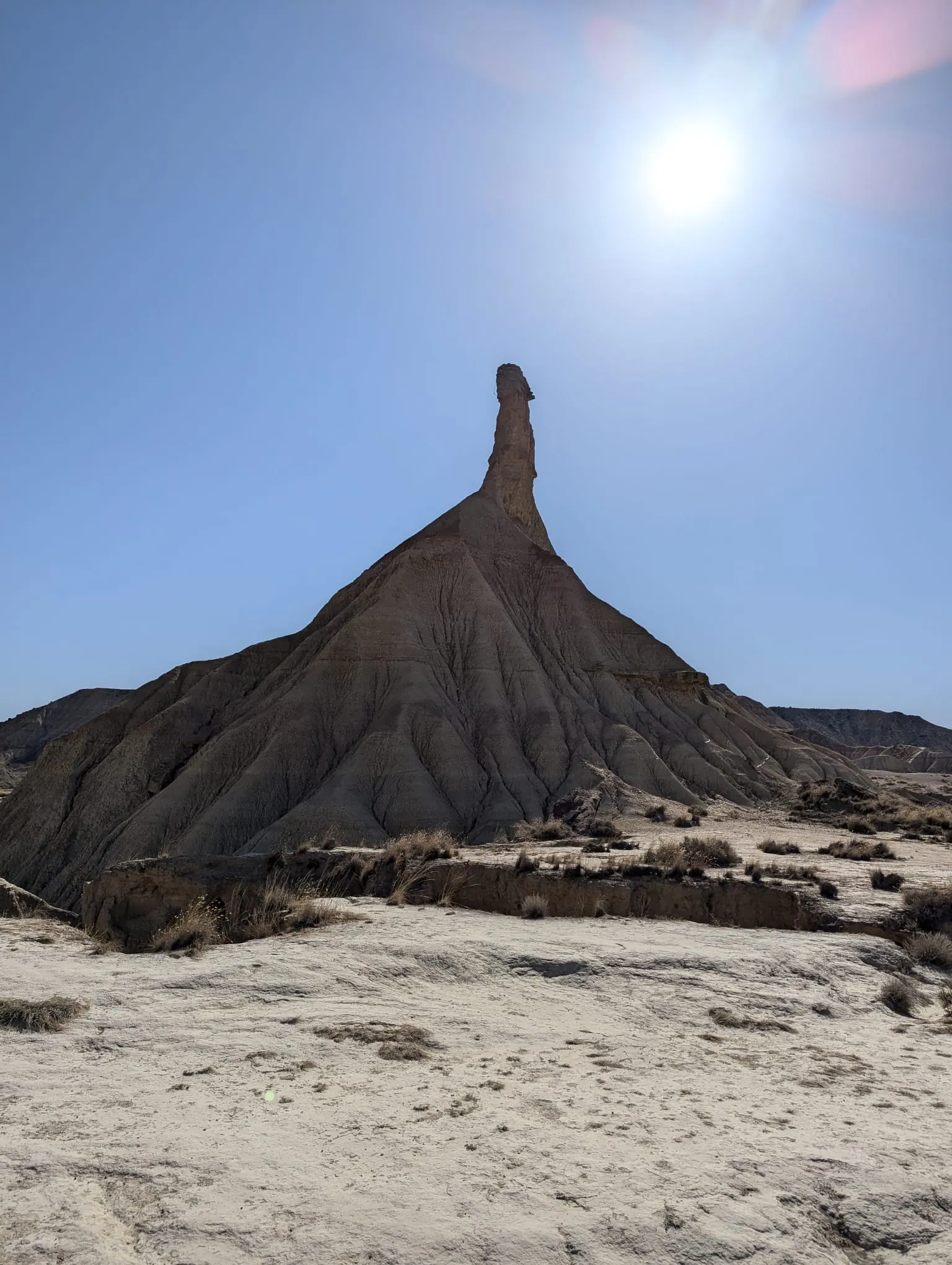
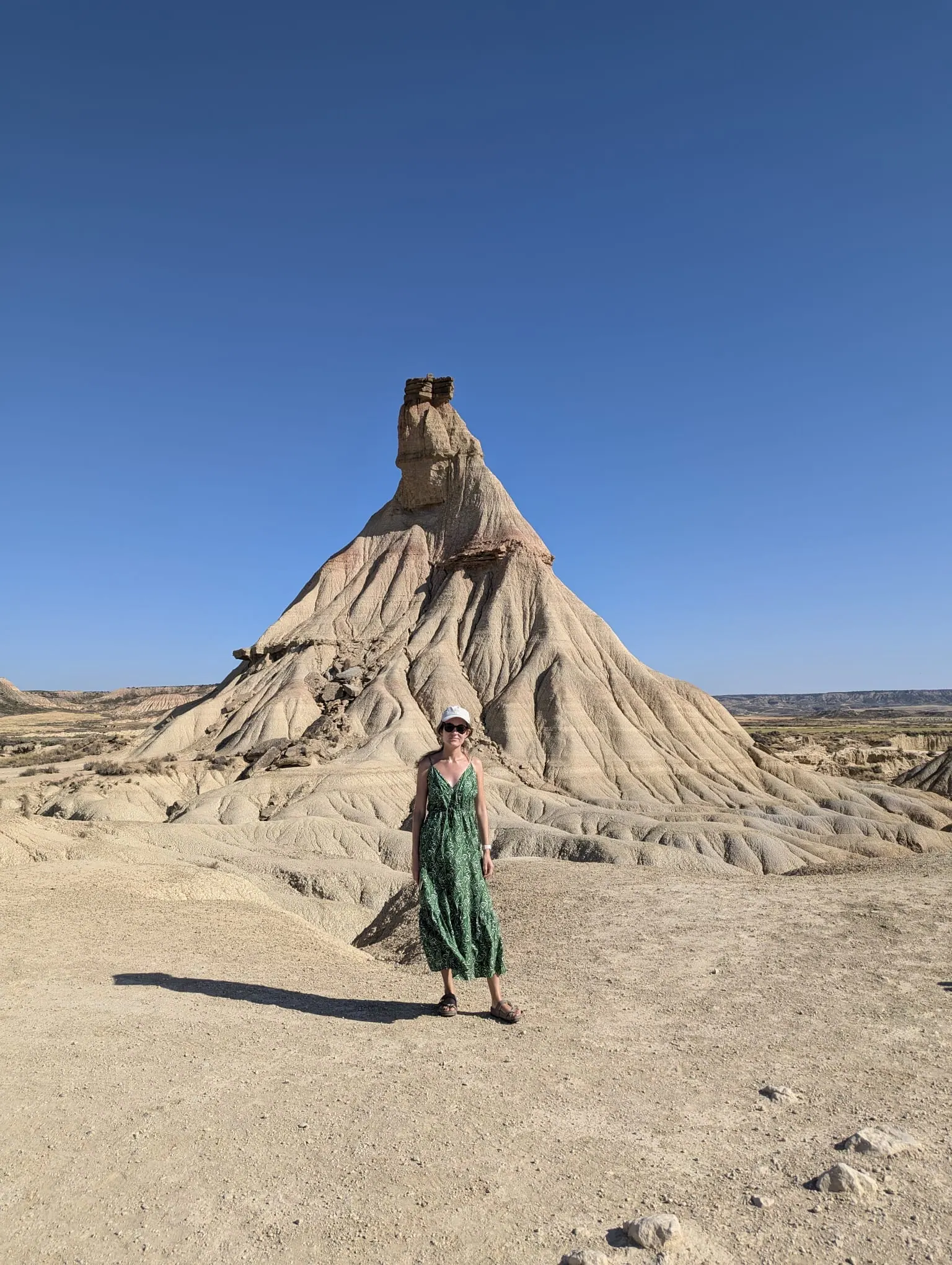
If Bardenas has one star, it is Castildetierra: a tall, lonely rock tower standing on its own, with a harder “hat” of rock on top. It is the symbol of the whole park and, not surprisingly, the busiest stop, where more people gather than anywhere else. What I liked most is that it looks completely different depending on which side you view it from - walk around it and it seems to change shape. It is worth the short stop even with the small crowd.
A few interesting facts about Bardenas Reales
- "Reales" means "royal." These badlands belonged to the kings of Navarra from the 9th century onwards, and grazing rights were handed to the nearby mountain valleys as a reward for helping in old battles. The land is still shared and managed communally today.
- Shepherds still cross it every year. Each autumn, thousands of sheep are walked down from the Pyrenean valleys to spend the winter grazing here, along drovers' roads used for centuries. You can still spot old stone shepherd huts dotted around.
- You've probably seen it on screen. The desert has been used in plenty of films and shows, including Game of Thrones (it stood in for the "Dothraki Sea") and a James Bond film. It's an easy landscape to recognise once you've been there.
- It has its own outlaw legend. A 15th-century bandit named Sanchicorrota is said to have hidden out here and fooled his pursuers by putting his horse's shoes on backwards, so his tracks pointed the wrong way. There's a viewpoint named after him.
A word about the heat
I have to be honest here, because it matters. We went in the height of summer, on a brutally hot day, and I ended up with sunstroke. There is almost no shade out in the desert, no shops, and nowhere to cool down, so the sun just sits on you.
So take the heat seriously. If you can, visit in spring or autumn instead, when the temperatures are far kinder. If you do go in summer, go early in the morning, and either way bring far more water than you think you need. It sounds obvious, but out there it is vitally important - there is nowhere to buy anything once you are inside.
Know before you go
- It's free. There is no entrance fee and no ticket. The park is open daily from around 8am until an hour before sunset.
- Start at the information centre. It is near Arguedas - we didn't spot it and asked at our hotel instead, but it's worth using to pick up a free map before you drive in.
- You need a car. There is no real public transport, the area is huge, and the whole point is stopping at different formations. A normal car is fine on the main route.
- Stay on the marked tracks and don't climb on the formations - the ground is fragile and easily damaged.
- Check for closures. Parts of the park close at certain times of year (roughly spring into summer) to protect nesting birds, so a track you want might be shut. It's worth checking the current situation at the info centre before you set off.
- Stock up first. There's no fuel, no food and no shops inside the park, so fill the tank and buy water and snacks in Tudela or Arguedas before you drive in. In summer, water is not optional.
- Best time to go: spring or autumn for comfortable weather. Avoid the middle of a hot summer day.
Where to stay: Arguedas or Tudela
We stayed right by the park in Arguedas, the small gateway town, at a rural guesthouse called Casa Rural La Bardena Blanca - good if you want to be as close to the desert as possible.
If you’d rather have a bit more around you, the nearest proper town is Tudela, about half an hour away, and it’s worth a little time in its own right. It has a compact old town shaped by centuries of Muslim, Jewish and Christian history, with a Gothic cathedral built over a former mosque and a lively main square, the Plaza de los Fueros. It’s also known across Spain for its vegetables - the market gardens along the Ebro grow famous artichokes, asparagus and more - so it’s a good place to eat well after a dusty day in the desert.
Worth it?
Yes, with one honest caveat: Bardenas is really about the landscape and the drive, not about “doing” a long list of things. If you’re the kind of traveller who loves strange, empty, otherworldly places, you’ll be very happy here. It’s an unusual spot, unlike anywhere else in Spain, and it fits perfectly into a road trip through the region - for us, it was the stop between Monasterio de Piedra and the Pyrenees. I wouldn’t cross the country just for it, but if you’re anywhere nearby, it’s absolutely worth a stop. Just not in the midday summer heat.
FAQs
Is Bardenas Reales worth visiting?
Yes, especially if you like strange landscapes, road trips and places that feel unlike the rest of Spain. It is best as a stop on a wider Navarra, Zaragoza or northern Spain route.
Do you need a 4x4 for Bardenas Reales?
No. A normal car is fine for the main driving loop, as long as you stay on the marked tracks and conditions are normal.
How long do you need in Bardenas Reales?
The main loop is around 30 kilometres and takes about two hours with stops. Add more time if you want other viewpoints, guided activities or Bardena Negra.
Read next
More posts for this trip mood
 Europe
 Balearic Islands, Spain
Things to Do in Ibiza Off-Season: Nature, Empty Calas & 4-Day Route
Ibiza off-season is a completely different island: empty calas, quiet hiking trails, and dramatic coastal views without the summer rush.
A 4-day off-season Ibiza guide focused on nature, empty calas, coastal hikes, Dalt Vila, Es Vedrà, and practical April road trip tips.
 Europe
 Valencian Community, Spain
Puntal dels Llops: The Iberian Fortress Half an Hour from Valencia
Puntal dels Llops is a small Iberian fortress from the fifth century BC, on a hilltop above Olocau.
 Europe
 Castellón, Spain
Peñíscola and Sierra de Irta: Castle Town and Coast Walk
Peñíscola's castle makes the first impression, but the wild Sierra de Irta coastline is what makes the journey memorable.
A practical guide to Peñíscola and Sierra de Irta Natural Park, with the castle, old town, beaches, coastal walking routes, Torre Badum, coves and 2026 summer parking rules.